
Marco Visconti - Chapter XIX
Special edition
by Tommaso Grossi
revised, edited and reworked by Gianfranco Maitilasso Grossi
THE LORD OF LUCCA
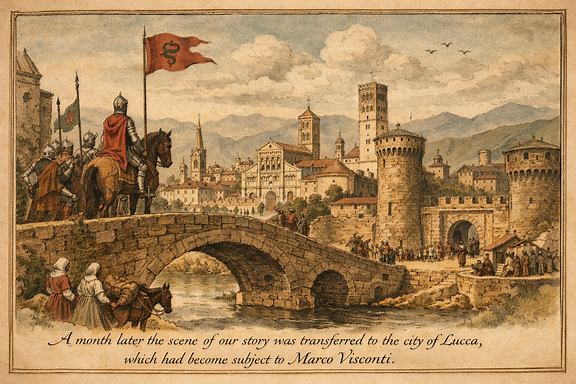
A month later, the scene of our story shifted to the city of Lucca, now under the rule of Marco Visconti. The Emperor, forced to abandon Tuscany after his own schemes—and those of the anti‑Pope—had collapsed, sought to squeeze every last profit from the land before his departure. Among his ingenious plans, one stood out for its cynicism: selling loyal cities for ready gold. Lucca was the most notable of these transactions.
The faithless Bavarian stripped the city from the sons of Castruccio, his former ally, and handed it to Francesco Castracani degli Interminelli, who paid a staggering sum in gold florins. But the people of Lucca, unwilling to be bought and sold like cattle, turned against the Emperor and sought protection from Marco Visconti.
Marco had already arrived at Ceruglio, where he won over a band of rebellious German soldiers. With six hundred men, he marched to Lucca, drove Castracani away, and was proclaimed lord and captain of the city he had freed from an odious yoke—a city that willingly offered itself to a prince of noble birth and distinguished reputation, once the close friend of the great Castruccio, under whose rule Lucca had become so formidable.
Six days had passed since that triumph. Marco was still occupied with receiving the voluntary submission of nearby estates and castles, while his troops ravaged and burned those that refused obedience. He had already struck a new pact with Count Fazio—to play the same game at Pisa, wresting that city from Messer Tarlatino di Pietra Mala, to whom the Bavarian had granted it.
It was late. Having dismissed the counselors and nobles of his new court, Marco paced the vast hall of the municipal palace—once inhabited by his celebrated friend Castruccio. From time to time, he turned toward a Gothic window overlooking the square, where towers and domes gleamed under the firelight. Below, a great bonfire cast its red glow over the crowd, who feasted and sang ballads in praise of their new lord.
Marco paused to watch the scene, then turned away and lifted his gaze to a portrait of Castruccio hanging above the hearth. The sight darkened his mood and shattered the enchantment.
He murmured to himself: “At Rome, when he was the Emperor’s right hand—vigorous, feared by all the Guelph cities, by King Robert, and even by the Pope—how proud I was to call him friend, hoping through him to gain Milan. Suppose a soothsayer had told him then: ‘Castruccio, in a few months you will be under the earth.’ What a prophecy for a man in the prime of his power!
Life is fragile, yes—but imagine if that same conjuror had said: ‘Do you see the man beside you, the one you honor as a brother? This Marco, who helped you rise—soon he will rule your city. Your house will be his, your widow and sons will wander in exile, and he will inherit all you built.’
What a pitiful creature man is! A great and powerful city falls into my hands in an instant, while years of effort to seize another—Milan—still vanish like a phantom.”
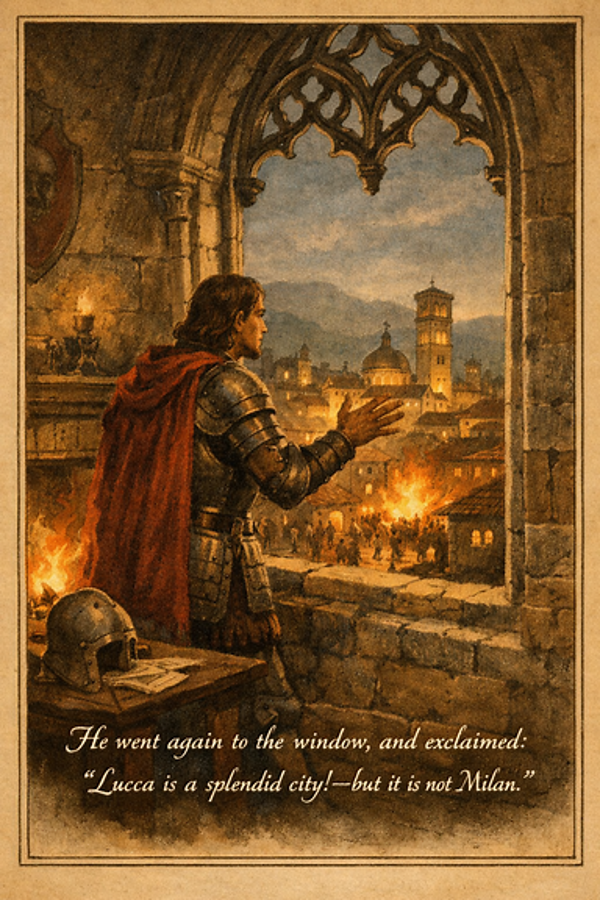
Marco returned to the window and exclaimed, “Lucca is a splendid city—but it is not Milan.” He sighed. “To rule where I once obeyed, to command where I was a subject, to be powerful among friends who rejoice in one’s greatness, to be helped by them—and yes, even to stand among enemies and watch them gnash their teeth, to triumph in their humiliation—that is life!
Here, the hills smile, clothed in vines and olives; knights are gallant, ladies are fair, wealth abounds, manners are polished—but none of this stirs Marco’s heart.”
A page appeared at the door, bowed deeply, and stepped forward with a packet of letters. “Despatches from Lombardy, my lord. The courier waits below—he says he is your retainer, named Pelagrua.”
“Let him wait,” Marco replied.
He moved toward a lamp and began examining the superscriptions, tossing each letter onto the table as he recognized the sender. Suddenly, one envelope caught his eye. He started, rang a silver bell, and asked the page, who reappeared instantly, “These were not all brought by one messenger?”
“All by your retainer, my lord—except one, which was left at the palace by a courier who continued on to Rome.”
“Very well,” said Marco, dismissing him.
He threw the last letter onto the table and muttered with a bitter smile, “My magnificent nephew! What condescension!” Then he picked up one of the earlier letters and began to read.
It was from Lodrisio, his counselor. Since Marco’s departure from Milan, Lodrisio had kept him informed of every event—each week a courier traveled with letters and ciphered replies. When word spread that the Emperor was marching toward Lombardy, Lodrisio urged Marco to follow with the rebel Germans from Ceruglio and strike the Imperial army’s rear—a plan Lodrisio himself had conceived—while he would raise Milan and meet Marco with the city’s troops, ever hostile to Azzone and unwilling to admit the famished, thieving soldiers of the deceitful Emperor.
But at that time Marco was not his own master. The rebel Germans were not yet fully loyal, and he could not risk leading them against their sovereign. Besides, he had already conceived the affair at Lucca—then merely as a way to secure funds to make those Germans more obedient.
Unexpected events, however, had shattered all plans in Milan. The people’s fervent devotion to Marco waned once his generosity ceased and his presence vanished from the streets. The Lombard nobles who secretly favored him grew disheartened by his inaction.
He still received support from the ecclesiastics sent by Pope John to aid his cause, but when they saw him idle at Ceruglio while the Bavarian advanced toward Lombardy, they sought reconciliation with the other side to save themselves and the Church’s influence from ruin.
Their defection was easy. The future looked bleak for them—and scarcely brighter for Azzone. The new lord of Milan trembled before the Emperor’s wrath, knowing that the Bavarian’s undisciplined army was marching north, furious with him.
Thus, reconciliation came swiftly. Azzone made the first overtures to the clergy, hinting at submission, and they welcomed him eagerly. His first act was to declare against the Bavarian and strive to wrest the territory from him. In this way, the new lord of Milan found safety in the very means once prepared for his downfall.
Marco had been informed of all this from the beginning. Lodrisio’s letter described how Milan was fortifying herself in feverish haste to resist the Emperor; how Monza, Lodi, and other cities vowed to perish rather than open their gates; and how, for their own intrigues, this was no longer the time to proceed.
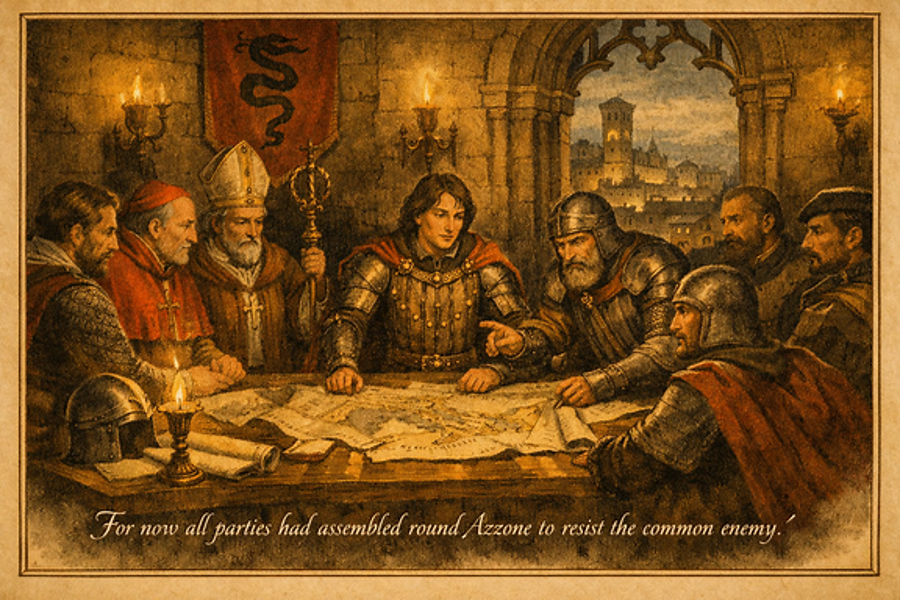
For now, all parties had gathered around Azzone to resist the common enemy.
Marco folded Lodrisio’s letter and murmured, “Tell Lodrisio he may rest easy. I know Ottorino well, and I’ll vouch for his loyalty—through every turn of fortune.”
Pelagrua hesitated. “Oh, I never meant—I only said—I would never harm him.”
“No, beware of it,” Marco replied sharply, then fell silent. After a moment, he burst out, “And what was said in Milan of the unknown knight who unhorsed Ottorino?”
“Some claimed it was Rusconi’s son; others, a knight of King Robert’s. But when the wounded boy regained his senses, he told his friends that no one in Italy but you could strike such a blow.”
Marco’s expression softened. “He wasn’t seriously hurt? He’s recovered, isn’t he?”
“There isn’t even a scar. He’s as lively and handsome as ever—so the Count’s daughter will have no reason to complain.”
Marco turned abruptly. “And what news of her?”
“Of whom?”
“Of Beatrice—the Count’s daughter.”
“All I know,” Pelagrua answered, “is that after the joust she hovered near death for four or five days. Then the fever returned, and her parents nearly lost their minds, never leaving her side until she slowly recovered. She’s still restless—her head full of childish whims—but nothing serious.”
“Watch your tongue, you insolent cur!” Marco thundered. “By the Holy Rood, I’ll give you something to remember!”
He pointed to the door, and in an instant Pelagrua was gone.
Left alone, Marco sat at the table and wrote five or six letters, then summoned his seneschal and handed them over with detailed instructions for their delivery.
“As for Ottorino,” he said, “I’ll see that he doesn’t show his face in Milan. If he ever does, Count del Balzo must not receive him. Keep your eye on him, as you’ve done—and if anything new happens, inform me at once.”
“I will,” replied Pelagrua. “But suppose I discover—people say the young lady is already betrothed to him, that a wedding is being arranged—even her father—”
“You must prevent it,” said Marco coldly.
“But how? If—”
“In any case,” Marco repeated, “you must prevent it.”
“I understand,” muttered the knave to himself. “I see it all.”
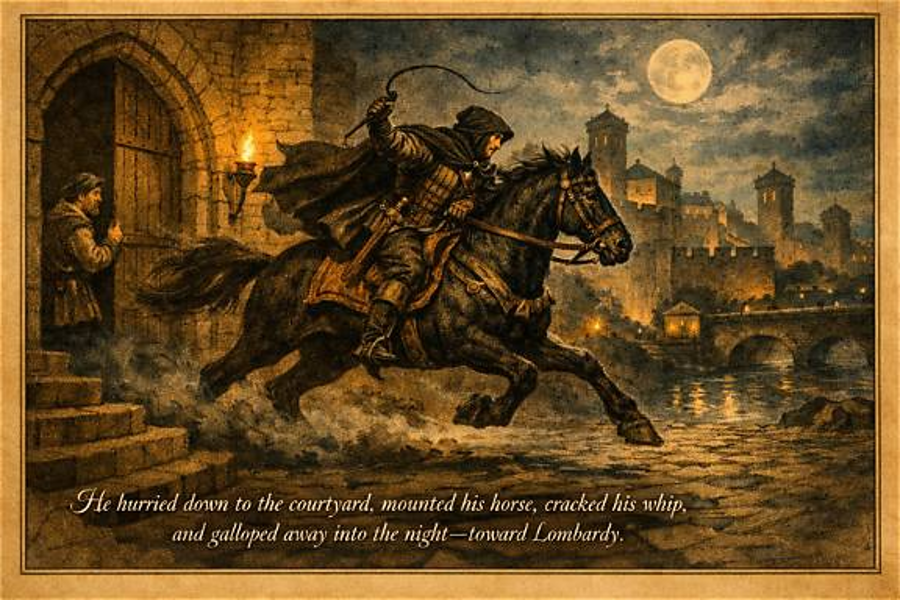
He hurried down to the courtyard, mounted his horse, cracked his whip, and galloped away into the night—toward Lombardy.

Will follows the "CHAPTER XX– "Reinforcement for Milan".
Every Friday a new chapter will be published which will also contain the link to the previous one, in any case you will find the list of chapters and their links on the following page: "Marco Visconti - CONTENTS"
Of course, only published chapters have a link to the relevant page.
The first and second chapters are open to all, and exceptionally the chapter X, the others are reserved for paying subscribers.
THIS IS A SPECIAL COPY OFFERED TO ALL TO PROMOTE THE ROMANCE
I invite you to subscribe as soon as possible by taking full advantage of the discounts provided and the whole story. As with this chapter we joined the middle of the season.
I suggest you make the most of the special edition offer of only € 39 instead of € 79,99 for the normal annual tier.
please check here:
https://www.truthdead.com/mid-season-recap-special-edition/
to have all the information.
Later the Spanish and Italian versions will also be published, as well as the episodes of the television series produced in Italian and possibly subtitled.
Enjoy the reading.