
MARCO VISCONTI - CHAPTER X
by Tommaso Grossi
revised, edited and reworked by Gianfranco Maitilasso Grossi
Editorial Intro
This chapter marks the moment when the story truly comes alive.
Tensions sharpen, hidden motives surface, and the banquet at Marco Visconti’s palace becomes the turning point where destinies begin to shift. What was once only hinted at now takes shape — and from here, everything accelerates.
If you’re reading this as a non‑subscriber, consider this chapter a glimpse of what you’ve been missing.
The most dramatic and revealing developments of the novel unfold in the chapters that follow.
Don’t miss what comes next.
THE BANQUET
As soon as Marco saw Ottorino enter the room—where he sat alone, reading through some papers—he rose and hurried forward to greet him warmly. “Back already!” he said. “And how do matters stand in Monza?”
“There is universal discontent,” the young man replied, “but no one dares lift a finger for fear of the Duke of Tech.”
“And whom did you speak with?” Marco asked.
“With the leaders of the Guelph faction you mentioned—Guzino Gavazza, Moneghino Zeva, and Berusio Rabbia. The last of them will come to Milan as soon as he can slip away without arousing suspicion, so he may confer with you.”
“And what news of the common people?”
“The worst possible. I must tell you about your priest, Martino—the one you sent as a missionary. He barely escaped alive from the hands of those fine fellows he had begun to instruct.”
“Are they so devoted to the anti‑Pope Niccolò?”
“It isn’t that they care more for Niccolò than for Giovanni. They’re a lawless crowd who only want to fish in troubled waters.”
And here Ottorino recounted everything that had happened in the church at Monza.
“Brutes!” said Marco, smiling at the tale of their heroic exploits. “Brutes! But it’s the same everywhere. Well—enough of that. My aim is first to tangle matters thoroughly, and then, in due time, to set them right again. And now, about poor Martino—”
“I assure you he has lost all desire to preach, and he will carry the marks of his adventure for some time.”
“To tell the truth,” said Marco, “he played his part rather foolishly. But one doesn’t need to live a hundred years to know that when the mob rises, they become wild beasts and seize whatever they can reach. Let them be. After all, there’s no great harm if a few gold coins fall into the pockets of the poor—coins taken from the gold and silver endlessly piled up in sacristies as candelabra and crucifixes. Why can’t we be good Christians and still have lamps of glass or earthenware, and crosses and candlesticks of wood? And besides—where did all that gold and silver come from? Out of the pockets of the poor, I say. What truly matters is whether they’re too attached to the schismatic side.”
“On that point you may rest easy. In my opinion, they know nothing about either Pope or anti‑Pope. To prove it: after mistreating poor Martino, who preached for Giovanni against Niccolò, they turned on a second orator who spoke for Niccolò against Giovanni. He was a mountaineer from Limonta, come with Count del Balzo, and if I hadn’t arrived in time, they would have finished him off as well.”
“And Count del Balzo has arrived?”
“We arrived together, just now.”
“You see? The advice I gave you has had the right effect. Now that he is here, it will be my fault if we fail to make use of him. Let me think… He has his whole family with him, doesn’t he?”
“Yes, the whole family.”
“Tomorrow I shall give a banquet for my friends. Could you arrange to bring him with you? Ermelinda—I certainly cannot hope to see her. But this Beatrice you rave about—you may persuade her to accompany her father.”
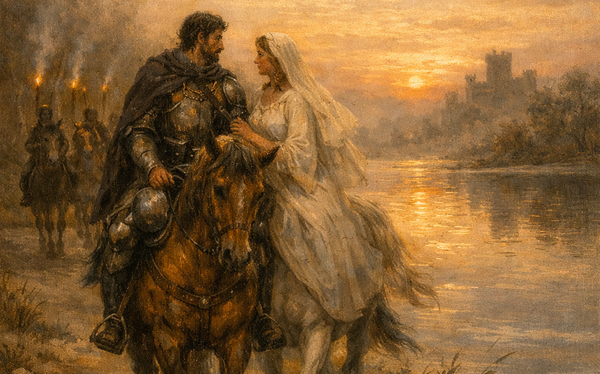
Ottorino, who could have wished for nothing better—since it was clear that if his patron was so eager to see his beloved, he would readily forgive him for abandoning Rusconi’s daughter—promised at once to obey.
The next morning, early, he went to the Count to tell him that Marco expected both him and Beatrice at dinner, and that he must allow her to go, for it was a great honor and would greatly increase his standing in Milan. In short, there was no avoiding it.
Ermelinda, to whom the Count announced the matter as already settled, saw no way to oppose it. The girl might fairly be considered Ottorino’s betrothed, since he had formally asked for her hand; and it was natural that the young man should wish to present her to his patron to gain his approval, especially since Marco had been involved in the earlier engagement, which ought not to be broken without his consent. Yet she could not help feeling a secret dread—born of memories of the past and forebodings for the future—at the thought of her daughter being presented to Marco. And when she finally gave Beatrice permission—who herself was somewhat frightened by all she had heard of that formidable personage—she felt as though she were sealing her daughter’s destiny forever. As she watched her depart, her eyes filled with tears.
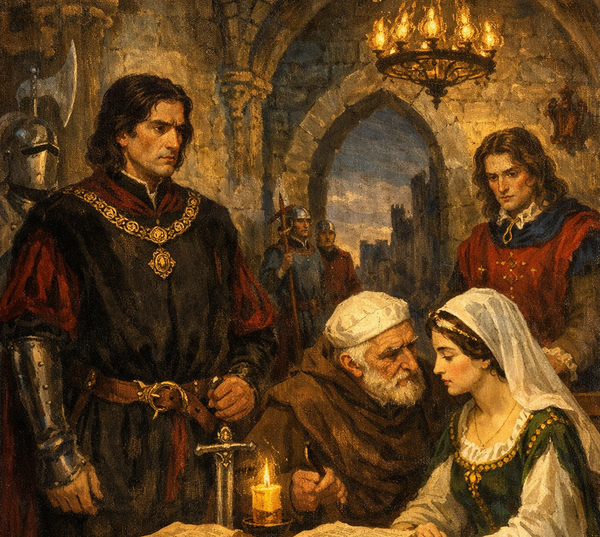
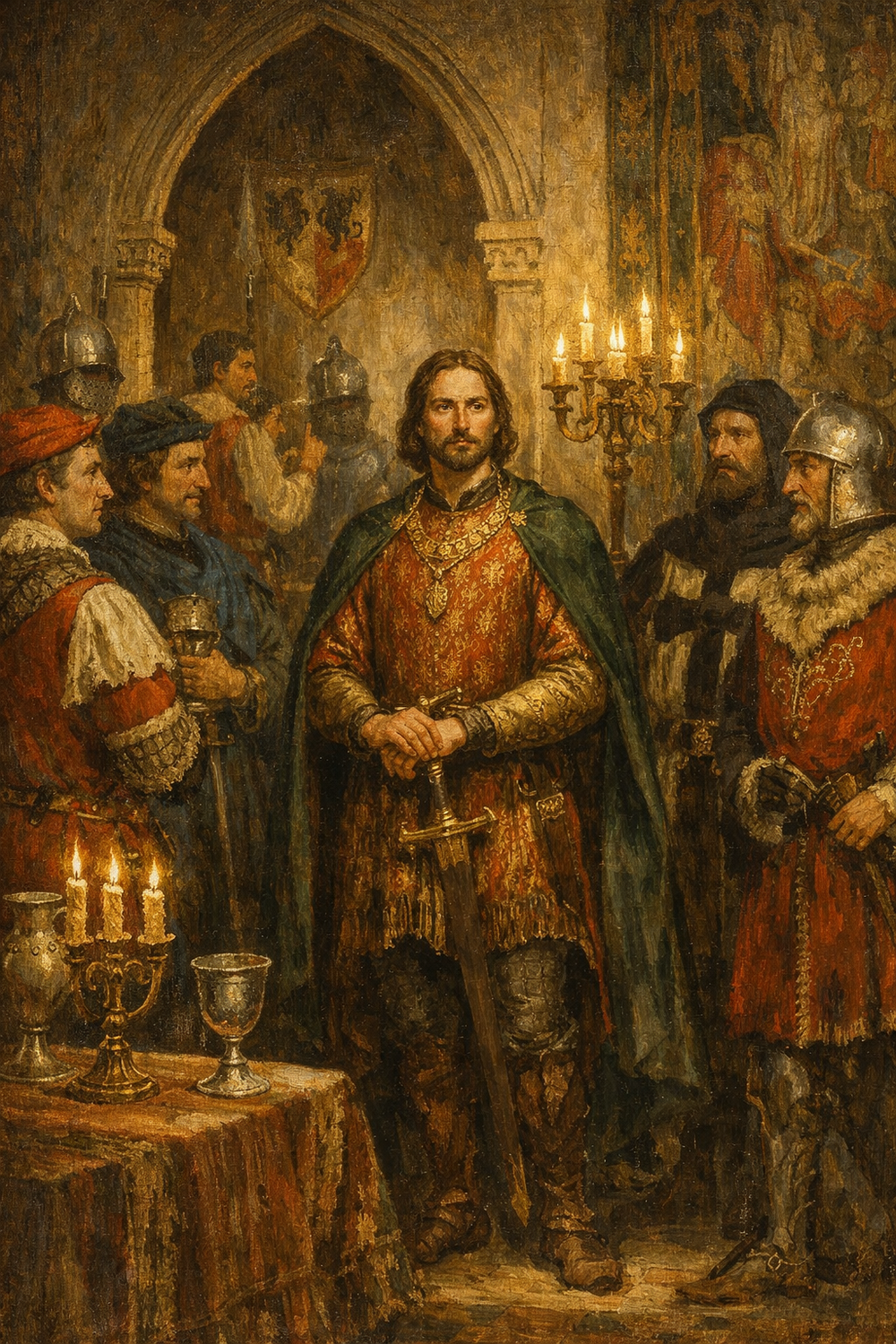
Marco Visconti stood in one of the reception rooms of his palace, surrounded by a circle of Milan’s finest knights, awaiting the announcement of dinner. Always magnificent in his entertainments, he had on this occasion pushed extravagance to the edge of prodigality, eager to attract partisans and to flaunt his wealth before the crowd—so easily dazzled by anything that glitters.
One of the foremost figures among his followers was Lodrisio Visconti, brother of the usurping Abbot of San Ambrogio—Marco’s most trusted adviser and instigator in many secret dealings. He was a handsome, powerful man of about forty, but restless and turbulent in spirit; though once well‑spoken of, he was destined to earn a far darker fame. He had long hated Ottorino, jealous of the affection Marco bore him, for he wished to rule Marco’s mind alone. He also resented him over certain lawsuits concerning the succession to the fief of Castelletto on the Ticino—finally adjudged to Ottorino. Marco had tried to reconcile them, and lately they had seemed on better terms. But Lodrisio had not abandoned his old resentment and watched constantly for a chance to ruin his rival.
A page now announced the arrival of Count del Balzo. All eyes turned toward the door, and he entered holding his daughter by the hand. Marco hurried forward, visibly agitated; for at the first sight of Beatrice—who came forward with lowered eyes and a deep blush—he imagined he saw Ermelinda herself once more, and for a moment his heart stood still.
He betrayed none of his emotion. He received the father with courtesy, though with a dignified reserve that, while cordial, could not fail to inspire respect; and to the daughter he paid every honor due to a noble maiden, entertaining her with light conversation until the pages entered to announce that the tables were ready. They then passed into an adjoining hall, where Marco seated Beatrice at his right hand and Count del Balzo at his left, while the rest of the company took their places around the table.
Toward the end of the meal, twelve valets in doublets and red‑and‑white parti‑colored hose entered the hall, bearing the gifts prepared for the festival. Some held pairs of greyhounds, setters, or bloodhounds, their collars of quilted velvet, their couplers and leashes of stamped leather. Another carried on his fist splendid hawks of various kinds, trained for the chase, with red jesses, white straps, caps embroidered with pearls, and tiny bells and silver ornaments on their breasts, engraved with the serpent crest. Another bore a sword with a golden hilt; another a steel helmet; others held aloft mantles and surcoats of embroidered damask, with silken cords, pearl buttons, and golden tassels.
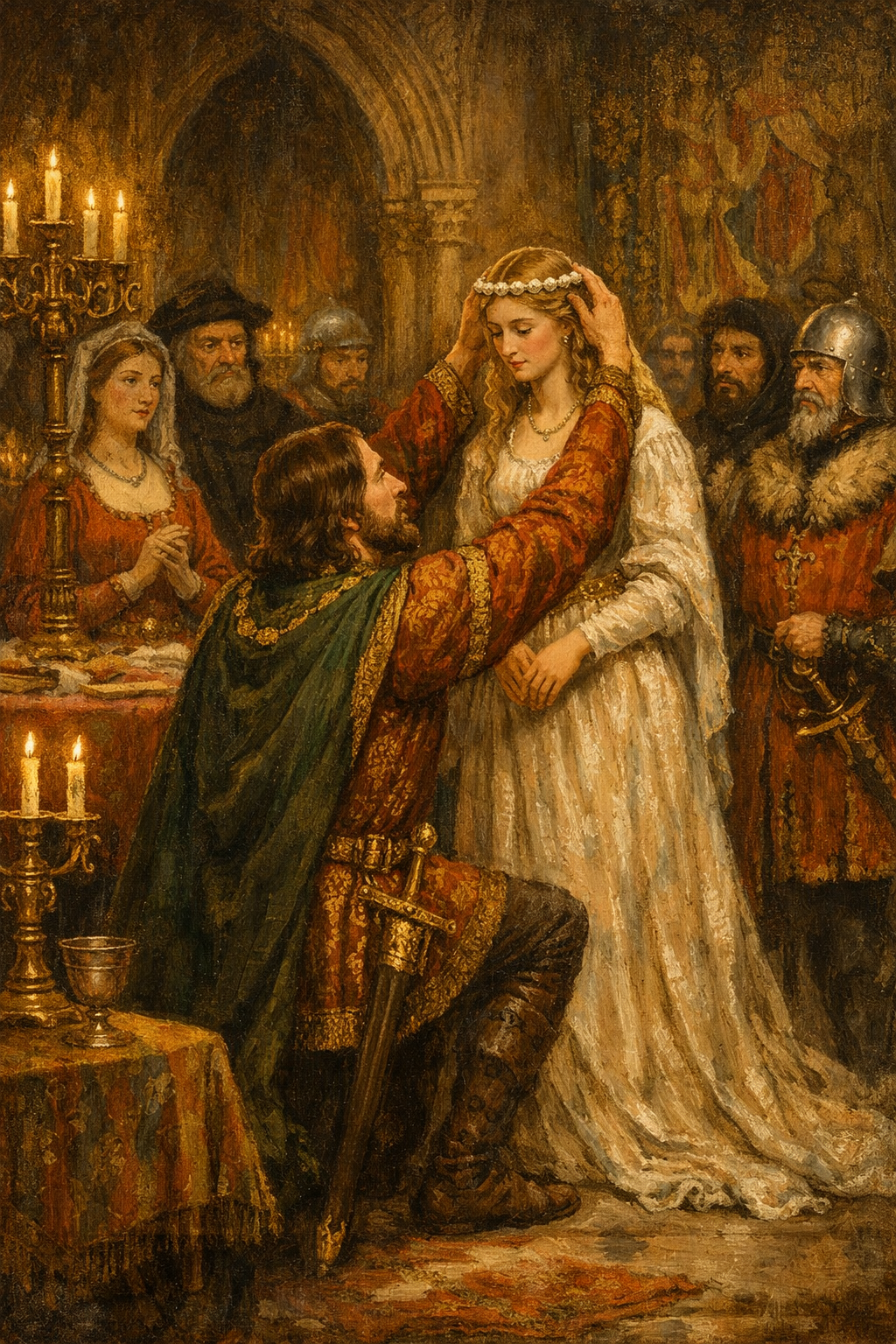
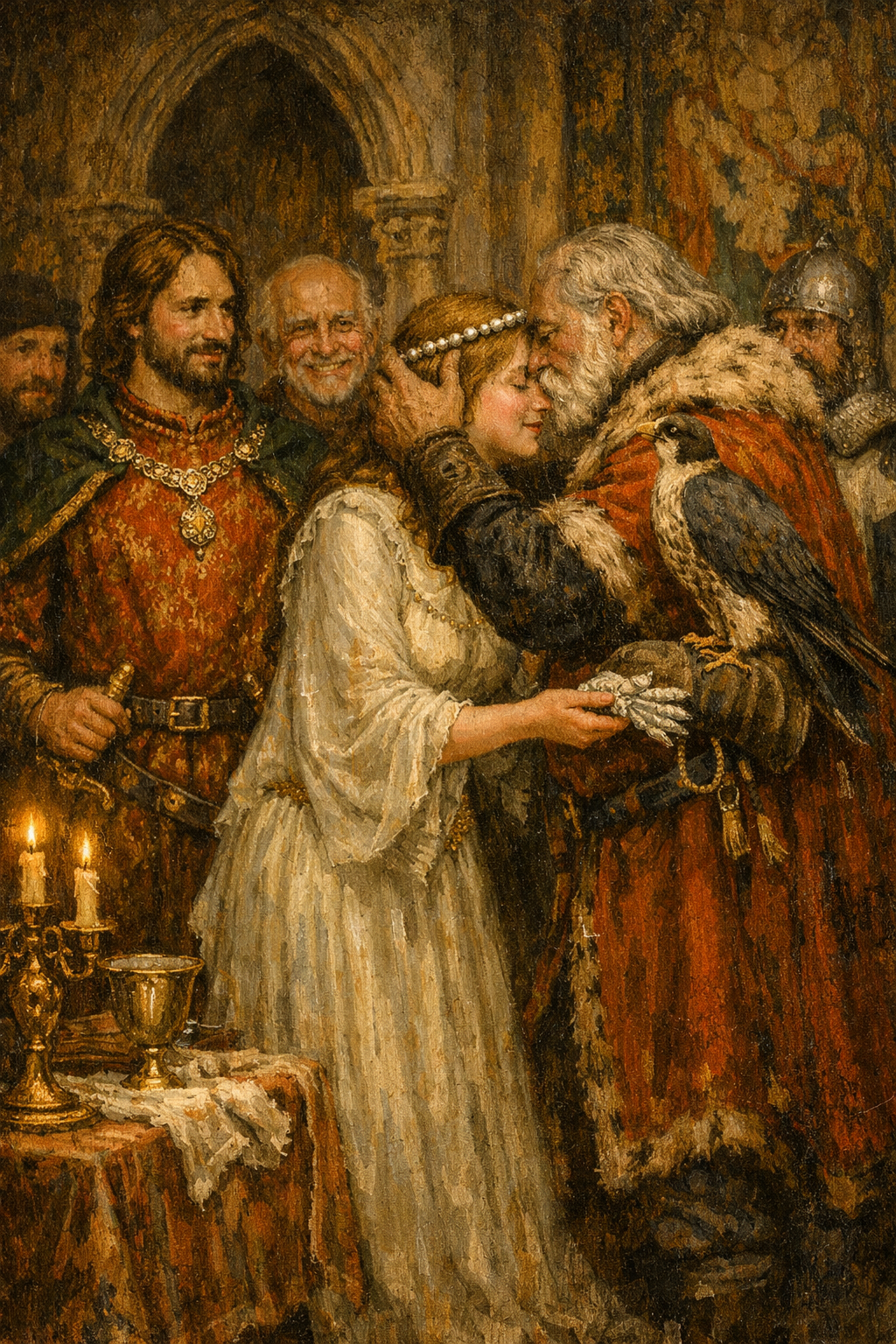
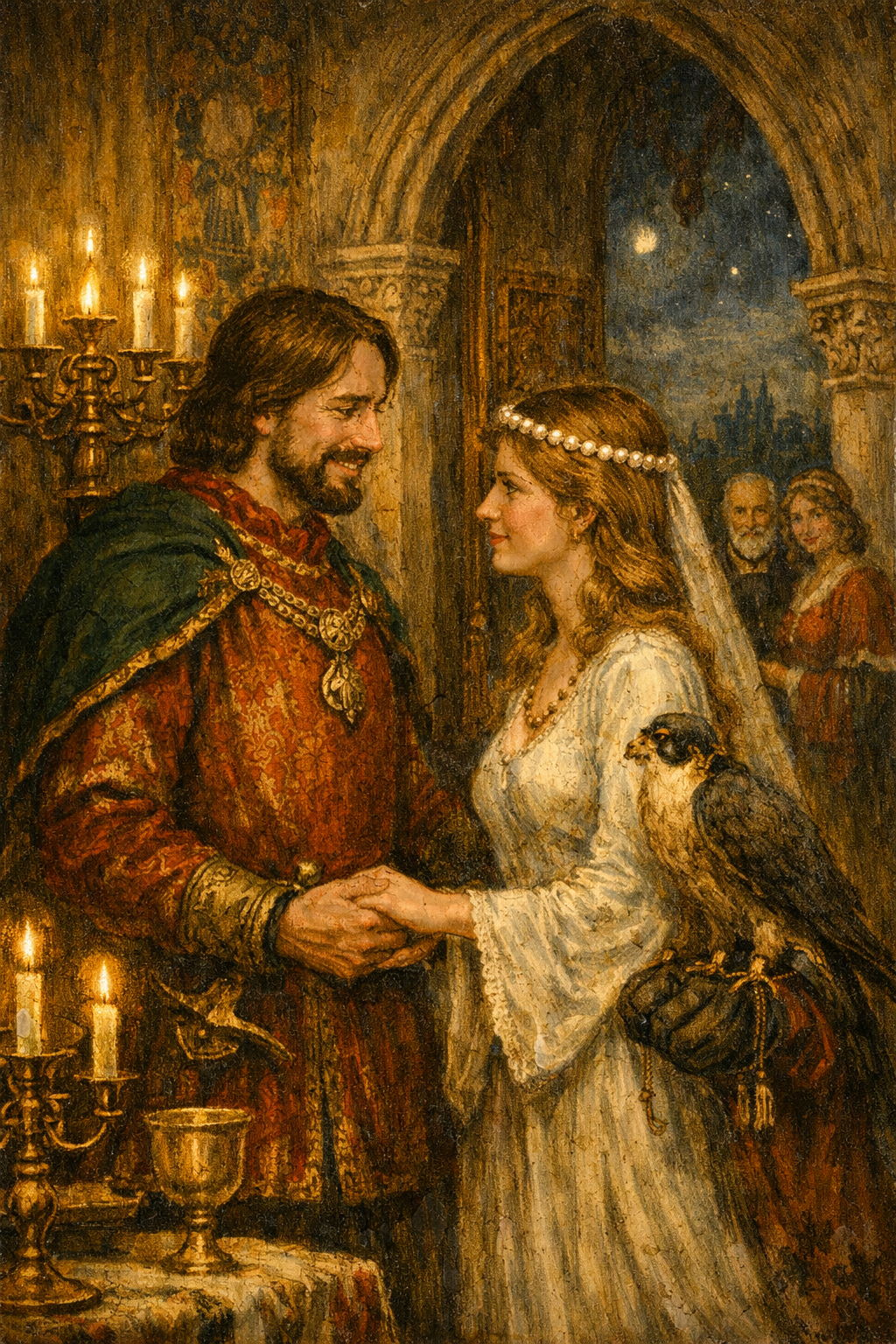
When these pages approached with the gifts, Marco noticed that none of them was suitable for a young lady of noble birth. He signaled to one of his squires, who left the hall and soon returned carrying a coronet of pearls on a silver salver. Then the master of the feast rose, and taking the coronet in both hands, bent one knee before Beatrice. Rising again, he placed the chaplet gently upon her head, saying, “God save the Queen of the Feast.”
A shout of applause echoed through the hall.
This done, he begged the maiden—using his own words—to “lend grace to these poor gifts of mine by presenting them with your own hands to the knights and barons who have honored me with their company.” Beatrice rose, and all the guests followed her example. Marco himself, acting as her squire, led her around the tables; and as he received each gift from the pages, he handed it to her, one by one. With a graceful gesture she presented each to its recipient, who accepted the gift on bended knee, kissing the hem of the fair donor’s garment.
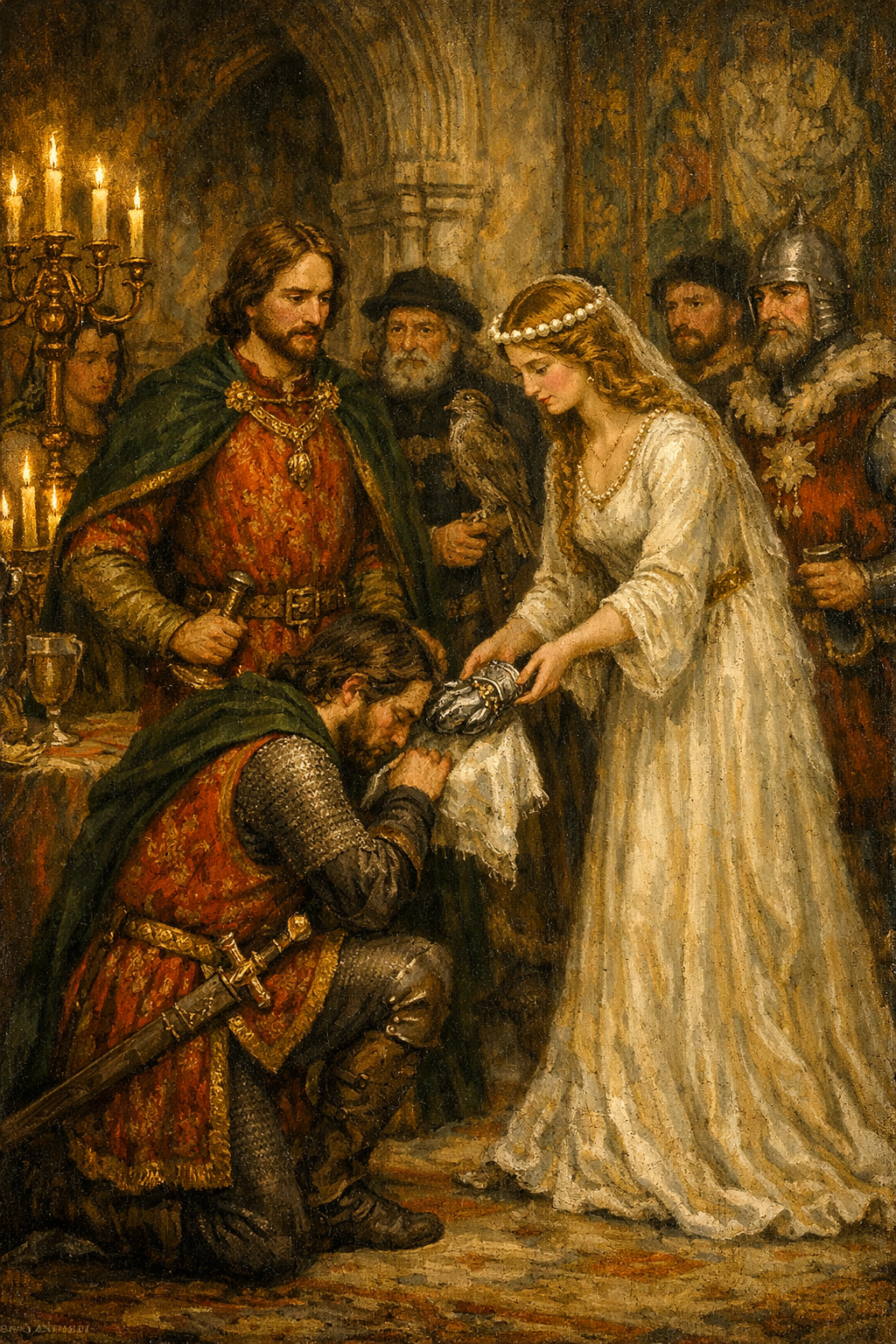
To Ottorino fell a steel helmet with an enameled crest, and it was noticed that the beautiful queen’s hand trembled more than usual when she offered it to him. But it was assumed that the weight of the armor was too much for the delicate wrist of a young girl.
The last to receive a gift was Count del Balzo, for whom Marco had reserved a magnificent peregrine falcon. He too accepted it on bended knee from his daughter’s hands and kissed the hem of her garment like the others; but as he rose, he could not restrain the warmth of his paternal affection. Throwing his arms around her neck, he kissed her forehead, saying, “God bless you, my daughter!”
A fresh cheer rang through the hall.
When silence returned, Marco said to the maiden:
“Most lovely and courteous queen, must I alone among your subjects go without one of your favors? If it is not too bold a request, might I hope to receive from your hands a ribbon—or any small token—as a sign that you accept me as your vassal?”
The girl grew confused and almost frightened; but her father urged her:
“Quick—give him something at once. One of those bracelets.”
She obeyed, slipping from her left wrist a silk armlet embroidered with gold. Marco received it on his knees.
When the tables had been cleared, the company broke into groups, discussing the news of the day. The conversation soon turned to the Pope and the anti‑Pope, and Count del Balzo quickly took command of the subject, seizing the opportunity to display his Latin and parade all the ecclesiastical lore stored in his head. The young knights—who could speak of little besides the merits of their swords and horses—were struck dumb by his extraordinary learning.
Before long, the talk shifted to a tournament announced that very day to celebrate the election of Azzone Visconti as Imperial Viceroy. After many questions had been asked and answered, Lodrisio drew a sheet of parchment from his breast.
“Here,” he said, “is the proclamation as issued by the town‑crier.”
The guests crowded around him, and he began to read.
When he finished, several voices cried at once:
“But what about the signatures? Let us see them!”
“Very well—here they are,” he replied. “Sacramoro Liprando, Ottorino Visconti, Bronzin Caimo, Pinala, Bertone Cacatossici, Pietro Meraviglia, Un Tanzo, Due Biraghi, Due Bossi, Lorenzuolo da Landriano. Given at Milan, Anno Domini 1329.”
Count del Balzo—who throughout the banquet had been thoroughly overawed by Marco’s innate stateliness, and had scarcely managed to stammer a few incoherent replies to the questions addressed to him—now felt his spirits revive. The honor paid to his daughter and the attention given to his earlier discourse emboldened him. Unable to restrain himself, he thrust his head into the circle of young men and said:
“So, you are talking of tournaments and jousts now, are you?”
—using that form of question which requires no answer and serves only as a pretext to join a conversation already underway.
“Do you know what the word ‘joust’ means? I shall tell you. It comes from juxta, the Latin for ‘near,’ because it is a combat in which the fighters come close together.”
One of the company, who did not seem eager for this display of learning, asked:
“And who will be the judges of the lists?”
But the Count, not allowing time for a reply, rattled on:
“You see, the custom of jousting is very ancient indeed. It dates back to the Trojan War, and returned to fashion in the days of King Arthur and the Round Table. That is why we call it Trojae ludus—the game of Troy—and also the War of Troy, because the Romans called war ludus, as though it were a game.”
No one spoke, but the orator could not help noticing from the faces and manner of his listeners that they took little pleasure in the study of etymology. He therefore judged it prudent to change the subject.
Seeing that his audience took little pleasure in etymology, the Count shifted to discoursing learnedly on arms and warfare—a subject toward which the conversation was already drifting.
Marco, meanwhile, had never moved from Beatrice’s side, speaking to her with an ease and cordiality that put her gradually at rest. When, as the hour grew late, her father approached to offer his hearty and grateful farewell, Marco accompanied the maiden to the edge of the hall. There, placing her once more in the Count’s care, he praised her extravagantly and showered him with compliments, ending by saying that he hoped their future meetings would make up for the long years of separation.
The Count left the palace in such high spirits that his feet seemed scarcely to touch the ground. As soon as he reached home, he told his wife of the honors paid to him and to their daughter. Ermelinda was greatly comforted by the account, convinced that Ottorino must have spoken to Marco about his intended marriage to Beatrice, and that the courtesy shown by Marco was a sign of his approval.
Soon afterward Ottorino himself arrived, in a state of joyous excitement. As the conversation turned to the festivities of the day, he realized that both the Count and Countess believed Marco had indeed given his consent—and he did not care to correct them. After the welcome he had received, he felt certain of success, and resolved that at the first opportunity of being alone with his liege lord, he would say what he had been ashamed to say before so large a company. He therefore spoke of his future marriage with Beatrice’s parents as though it were already settled, and in truth, it took very few words to arrange everything.
At this point the Count exchanged a glance with his wife, then turned to Beatrice—who had remained silent throughout the conversation, not daring even to raise her head—and said:
“We have all been counting without our hostess. We have been giving you away without asking your leave, when perhaps this is the last thing on your mind.”
Beatrice felt her cheeks burn like fire. She grasped her mother’s hand but said not a word.
Ermelinda signaled to her husband to end his teasing, then said to Ottorino with a smile:
“Though such matters are not usually settled by proxy, I hope you will be content with the ‘yes’ that her mother now gives you on her behalf.”
The young knight rose to take his leave. At that moment the girl lifted her head and, still holding her mother’s hand, said softly:
“You will come tomorrow… won’t you?”
“Ha! ha! Now the cat is out of the bag!” cried the Count, roaring with laughter. “A moment ago you might have been a Saint Lucy. Oh, you little rogue!”
Ottorino departed in a state of perfect happiness—happiness fully shared by those he left behind.
Ottorino left in a state of perfect delight, and the joy he carried with him was fully shared by those who remained behind. The Count and his wife exchanged satisfied glances, convinced that the day’s events had secured their daughter’s future and that Marco’s favor now shone upon their house.
Beatrice withdrew quietly to her chamber, her heart still fluttering from the emotions of the evening. The memory of the banquet, the splendor of the hall, the respectful homage of the knights, and above all the gentle courtesy of Marco—so different from the fearsome image she had formed of him—passed before her mind like a dream. Yet beneath her timid joy there lingered a faint, unspoken uneasiness, a shadow she could neither name nor dispel.
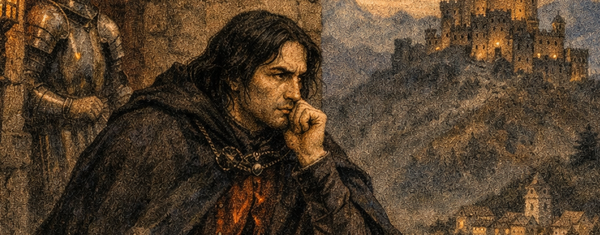
Meanwhile, Marco remained alone in the great hall after the guests had departed. The torches flickered along the walls, casting restless shadows across the tapestries. He stood motionless for a long time, his gaze fixed on the empty space where Beatrice had stood. The sight of her had awakened memories he had believed buried forever—memories of Ermelinda, of youth, of hopes long extinguished. A strange turmoil stirred within him, half tenderness, half bitterness.
At last he shook himself from his reverie and left the hall with a heavy step, as though carrying a weight he had not felt for many years.
Thus ended the day’s festivities—brilliant for all who had taken part in them, yet leaving behind, in more than one heart, the first tremors of a destiny already beginning to unfold.

Will follows the "CHAPTER XI – Love and Sorrow".
Every Friday a new chapter will be published which will also contain the link to the previous one, in any case you will find the list of chapters and their links on the following page: "Marco Visconti - CONTENTS"
Of course, only published chapters have a link to the relevant page.
The first and second chapters, and exceptionally this one are open to all, after which they are reserved for paying subscribers.
I invite you to subscribe as soon as possible by taking advantage of the discounts provided and the whole story.
Later the Spanish and Italian versions will also be published, as well as the episodes of the television series produced in Italian and possibly subtitled.
Enjoy the reading.


The Mouth of Truth is a reader-supported publication. To receive new posts and support my work, consider becoming a free or paid subscriber.
In questo spazio non si paga per entrare: si entra perché si riconosce un’eco,
un frammento di sé, un varco che merita di essere custodito.
Se desideri sostenere questo lavoro con un gesto libero, puoi farlo qui:

This space does not ask for payment to enter: you enter because you recognize an echo,
a fragment of yourself, a threshold worth preserving.
If you wish to support this work with a free and voluntary gesture, you may do so here:
En este espacio no se paga por entrar: se entra porque uno reconoce un eco,
un fragmento de sí mismo, un umbral que merece ser cuidado.
Si deseas apoyar este trabajo con un gesto libre y voluntario, puedes hacerlo aquí: