
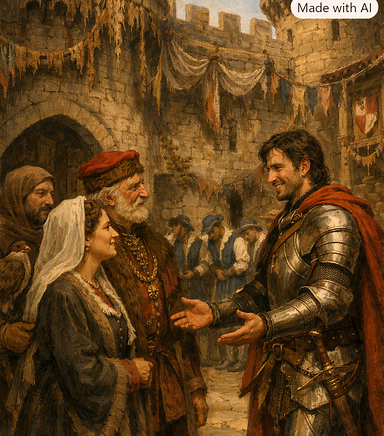
Marco Visconti - chapter XXV
by Tommaso Grossi
revised, edited and reworked by Gianfranco Maitilasso Grossi
A PRACTICAL JOKE
“Your husband says he will not be able to arrange your journey to the Holy Land until the end of the month; so, my child, I promise to come and see you once more, with your father, before then. We shall take leave of each other at Castelletto. Now, God bless you — within a week at the latest, we shall meet again.”
Such were Ermelinda’s last words as she tore herself, weeping, from Beatrice’s embrace on the day of their separation.
When the appointed time came, the good lady mounted her horse beside her husband, and, escorted by two retainers, they departed from Milan before dawn. By swift stages they reached Castelletto. Ambrose, the falconer, was one of the attendants — he wished to see his children, Lauretta and Lupo, once more before they too set out for the Holy Land.
As they approached the plain before the fortress, the travelers saw the towers, walls, and balconies adorned as if for a wedding. Ottorino’s banner fluttered from the highest pinnacle, while shields of varied shapes and colors, emblazoned with his arms and emblems, hung from the battlements. Rich draperies stretched from turret to turret, and on the ramparts were planted great branches and even whole trees, festooned with leaves and flowers. At intervals stood fanciful arbors crowned with pennons.
Yet the whole scene bore the melancholy air of festivity long past — the leaves were faded, the garlands drooping. Count del Balzo, after pausing a moment to contemplate the sight, turned to his wife with a chuckle: “See, the wedding decorations have not been taken down.”
As soon as the little party was seen from the castle, two servitors came forth to meet them, clad in short jackets of blue and white embroidery, each bearing a silver wand. One politely asked the falconer, who rode a little ahead, the names of the lord and lady who honored the castle with their presence. “They are Count and Countess del Balzo,” he replied.
At once the man blew his horn, and a troop of armed men issued from the gate, forming two rows on either side of the drawbridge to receive the newcomers. Soon afterward, a chime of bells rang from one of the towers, drowned in turn by shouts of revelry from within the castle.
Passing through a long vaulted passage, the travelers entered the courtyard — which looked, indeed, like a fair.
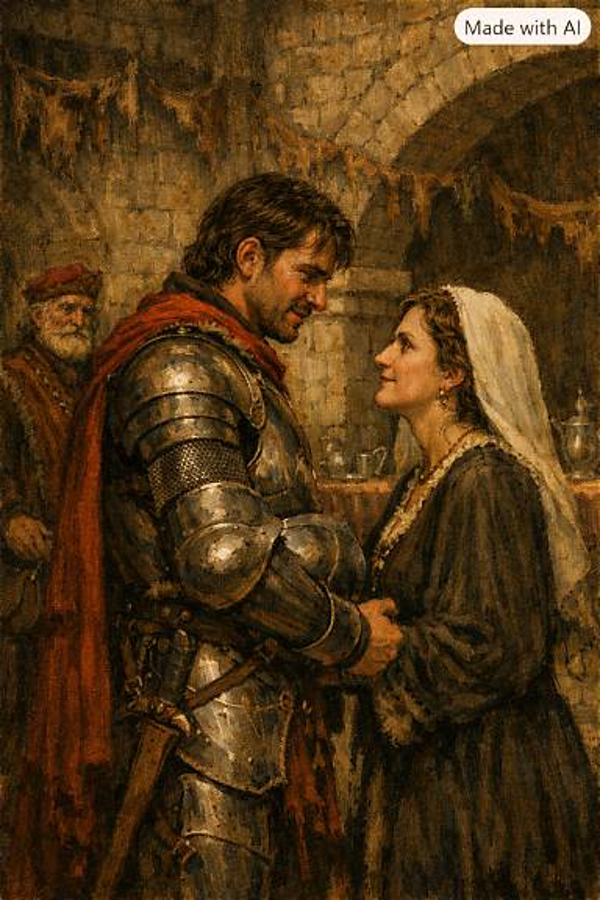
A crowd of men, women, and boys in festive attire came forward to greet them with loud shouts of welcome, echoed by jugglers with dancing dogs and a band of musicians playing every sort of instrument.
The falconer leapt to the ground and was about to help his mistress dismount when a red‑faced, stout individual pushed his way through the throng. It was the seneschal. He motioned Ambrose aside and just managed to reach the stirrup in time to perform his duty.
“Welcome!” he exclaimed, once he had caught his breath. “Welcome to the noble chatelaine from her faithful lieges!”
But suddenly, raising his head and looking closely at the lady’s face, he muttered something under his breath, then continued aloud: “The lady mother of our noble lady and mistress, I presume?”
“Exactly so,” replied Ermelinda.
The seneschal signaled the spectators to stand back and let the lord and lady pass. He then conducted them to a richly furnished room on the ground floor.
While Ermelinda, having seated herself, greeted the young maidens who came forward, the Count walked slowly about the hall with his hands behind his back, stopping now and then to examine the paintings on the walls.
“Is not that a portrait of Pico?” he asked the seneschal.
“Yes — Pico Visconti, father of my noble master,” replied the man with another deep bow.
“And this one is Maffeo, is it not?”
Just then the seneschal felt his coat tugged by a page. “The lady is asking for you,” whispered the boy.
“Yes, that is Maffeo, my master’s uncle,” answered the seneschal. “With your permission, I must attend to your noble lady, who has sent for me.”
He hurried to Ermelinda, who asked at once: “And where are the bride and bridegroom? Have you told them of Count Balzo’s arrival?”
“The bride and bridegroom?” repeated the man blankly.
“Yes — where are they?”
“But… are they not still with you?”
“Oh, I understand now!” said Ermelinda, smiling. “They must have come to meet us, and we missed them. No doubt they took another road. You had better send a messenger to fetch them back.”
The seneschal now looked genuinely troubled. “Do you mean,” he said slowly, “that they have not been staying with you? They have never arrived here. My master ordered me to be ready to receive him a week ago, but he has never appeared — and I thought he was all this time in your house at Milan.”
“Count!” cried Ermelinda, rushing toward her husband. “Imagine — they are not here!”
“Whom do you mean?”
“The children — Beatrice and Ottorino. He says he has not seen them!”
“What is this you tell us, seneschal?” stammered the Count. “That they have not arrived yet?”
“Certainly not. I believed they were at Milan.”
“And they did not come here last Saturday?”
“Alas, no — neither on Saturday nor any other day.”
“And have you had no news of them — no courier?”
“Nothing, as I tell you.”
“It is not possible!”
“Oh, I fear some evil has befallen them!” exclaimed Ermelinda.
“Gracious lady,” interrupted the seneschal, “pray believe me — the country is tranquil. A knight might ride through it night and day with his legs on his steed’s neck.”
(That was the way they expressed, at the time, that there was no danger from enemies or marauders.)
“And then,” added the Count, “they were not alone; besides the waiting‑maid…”
Free and voluntary gesture on Pay Pal