
Marco Visconti - chapter XXXII
by Tommaso Grossi
revised, edited and reworked by Gianfranco Maitilasso Grossi
THE CATASTROPHE
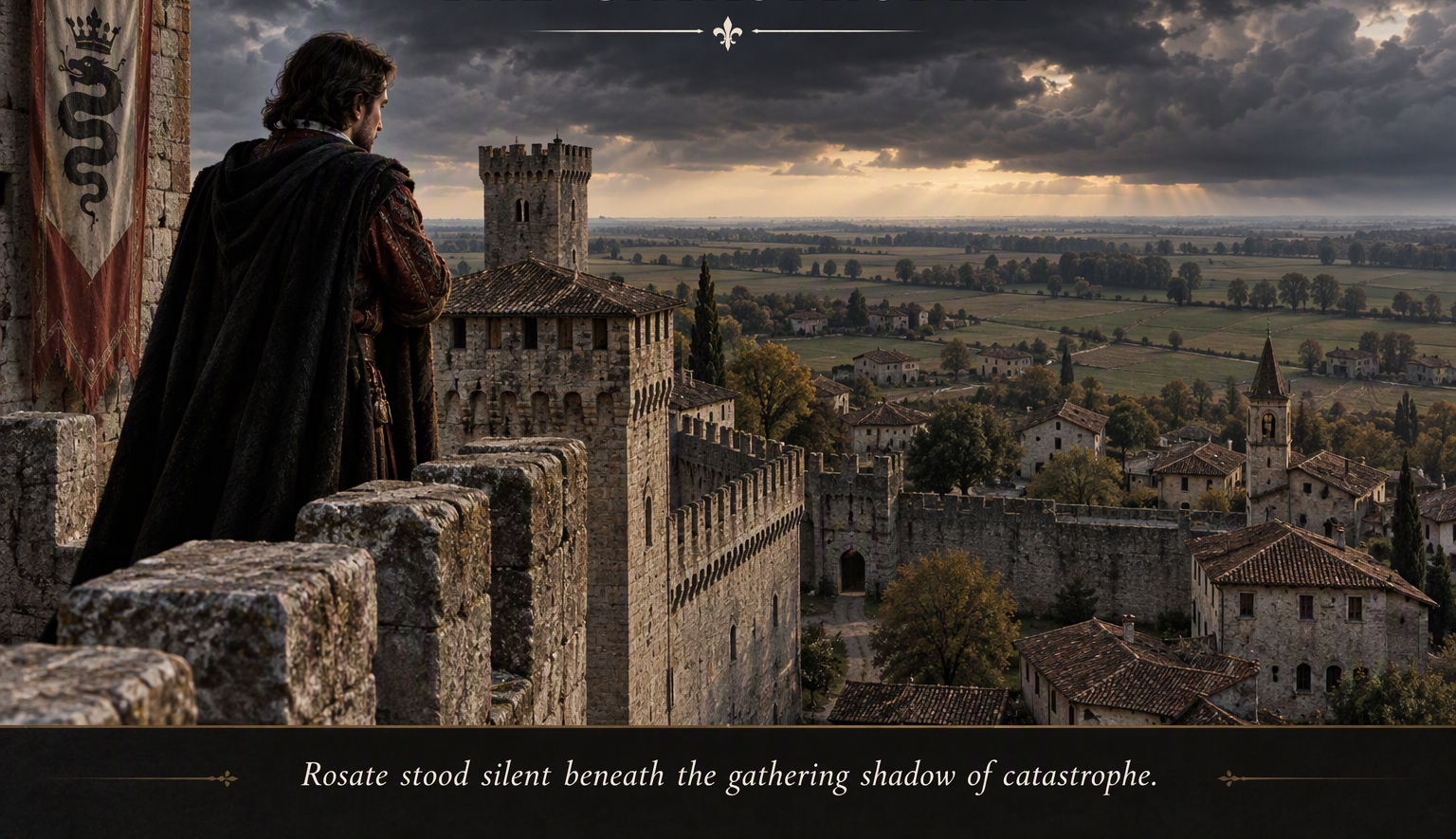
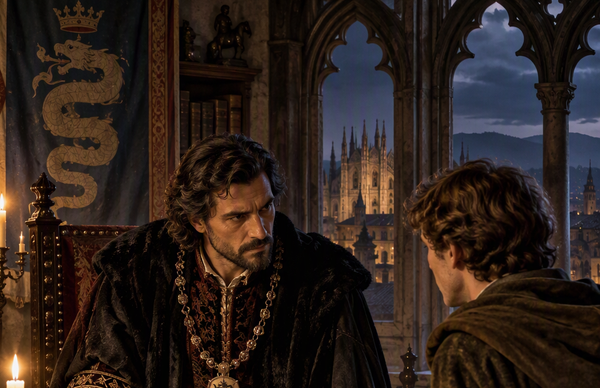
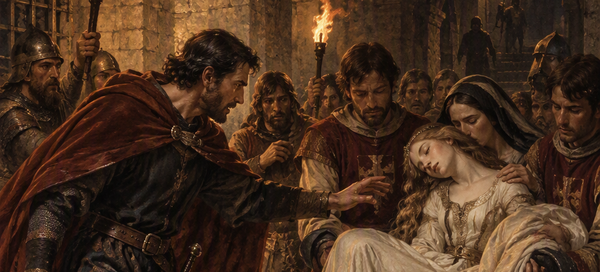
Marco hurried from the room, followed by Ottorino, who was deeply agitated, even amid the dire anguish of that fatal hour, by anxiety for the life of his lord. He also felt the necessity of tearing himself away from a spectacle that was more than he could bear, and of setting to work at something that would restore the equilibrium of his mind.
The great captain, drawing his hand across his face and eyes, as if wishing to drive away a dark cloud that obstructed his vision, strode along the gallery till he came to a turret staircase. He stopped for a moment before an open door, doubtful whether to enter or not.
But all of a sudden he felt suffocated. He must be in the open air, and so continued his hurried ascent of the stairs.
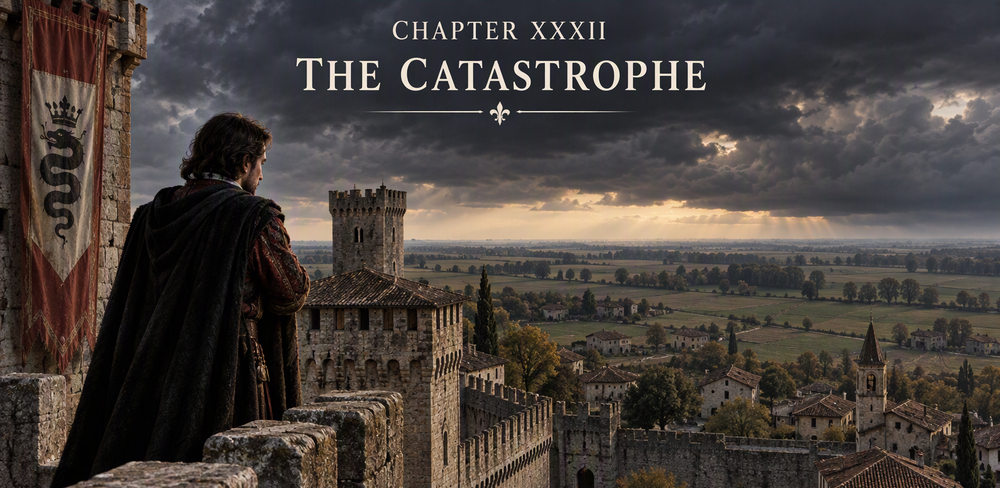
Higher and higher he went, till he came out upon the leads of a lofty tower. Here he stopped to breathe and to gaze at the magnificent view; then, drooping his head upon his breast, he folded his arms and leaned against one of the battlements for some time in silence.
His eyes were dry and motionless, his face stern and composed; but on his forehead the phantoms of the fierce thoughts that filled his soul seemed to chase one another in swift succession.
After a while he called to mind his youthful follower, who was standing at a distance, gazing at him in silence, and exclaimed,
“Why have you left her?”
“She is in her parents’ hands,” replied Ottorino.
“True,” rejoined Visconti, “and it ill becomes us to stay weeping here when we ought to be up and doing. Do you go down that staircase; on the first landing you will find the marshal’s room. Tell him to send Pelagrua up here, as I wish to ask him a question, and come back with him yourself, as I must have you here.”
Ottorino seemed to hesitate, but Marco guessed his thoughts.
“Do not fear to leave me here alone,” he replied. “What remains to me of life is not mine to dispose of, so long as I have wrongs to avenge, so long as a debt of blood remains upon my soul. When anguish shall have been paid for with anguish, then... But no, Marco never will die a craven’s death, despairing like an infidel.”
The young man departed.
Pelagrua was then in the castle. After the conversation he and Lodrisio had had with Beatrice, the two rascals saw clearly that it would be impossible to persuade her to acquiesce in any way to their iniquitous design. Therefore, seeing her strength diminish day by day, they resolved to free themselves from her once for all, she being, so far as they were concerned, an unwelcome, not to say dangerous, encumbrance.
The seneschal of Rosate, as has been related, on the very night that Marco arrived in Milan, and at the very moment he was conversing with Ermelinda, had shut up Ottorino’s bride and her maid in the dungeon, where he intended to leave them to die. He then went to Fallavecchia, a village near Rosate, and remained there until late in the evening.
On his return to the castle, little guessing, as may be supposed, the events that had happened in the meantime, he was taken into custody. Being examined by the marshal, he at first tried to put a good face on the matter; but on hearing that Marco was there, and that Beatrice had been discovered, he gave himself up for lost.
Two soldiers then seized him and forced him to go up to the top of the tower. At every step he implored Ottorino, who was behind him, to help him and save him from the first outburst of his master's fury.