
Marco Visconti - chapter XXIX
by Tommaso Grossi
revised, edited and reworked by Gianfranco Maitilasso Grossi
A MOTHER'S APPEAL
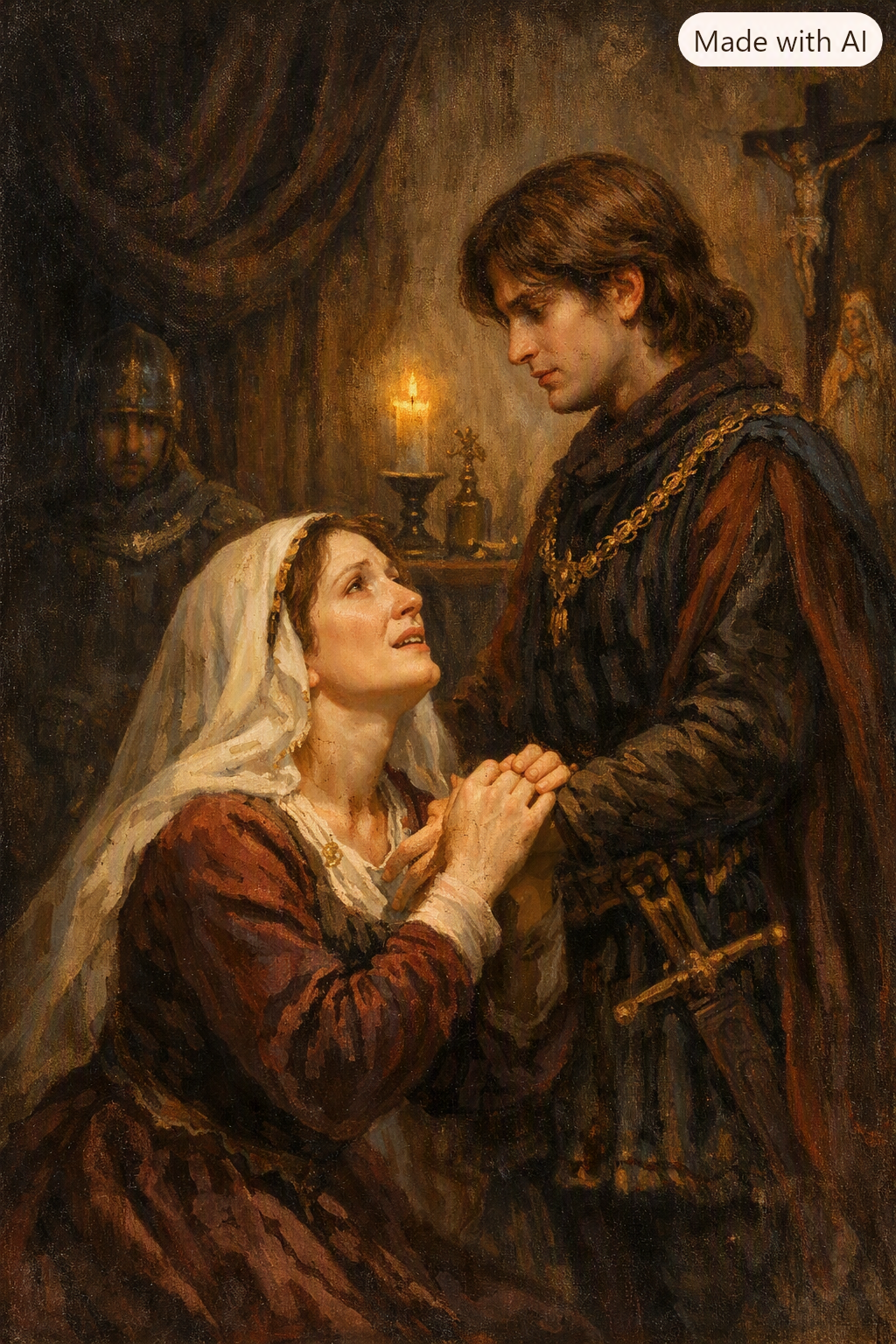
Since the last letter written by Marco to Lodrisio, which he had received from Pelagrua at the castle of Rosate, affairs at Lucca had gone from bad to worse. The German troops—adventurers utterly regardless of discipline—could no longer be controlled by Visconti.
Marco, who had to contend daily with this disorderly rabble, owed the little authority he still retained over them to the lustre of his name, the dignity of his bearing, and the readiness of his speech. Time after time, his mere presence had sufficed to make those turbulent soldiers lay aside their arms, which they were on the point of imbruing in the blood of his subjects. Time after time, he had ordered these very rebels to arrest their leaders; and such was the awe inspired by the dignified severity of his countenance, that they had never once ventured to disobey.
At the same time, he saw plainly enough by how slight a thread he upheld an authority disputed from the very beginning, and which had no intrinsic strength of its own. His original title he could not alter—and whence was intrinsic strength to come? It might be supposed that it should have been sought among the citizens themselves, who ought to have had the courage to unite in order to shake off those fiends incarnate from their backs. But the difficulty lay precisely with these citizens: part of them had never been able to look favorably upon Marco, part had lost what little affection they had ever borne him, and the rest had conceived a violent hatred against him.
The main reason why he was so universally blamed was that he had often winked at minor evils to avoid greater ones. For instance, he had more than once shut his eyes to abuses and encroachments on the part of those too-powerful troops, and had not been sufficiently careful to hold an even balance in the daily squabbles between them and the townspeople, so as to maintain the right of the weak against the tyranny of the strong. Not that Marco loved injustice; but his notions of justice were, like those of most soldiers, of a rough and ready kind, little inclined to ceremony—and besides, he had to maintain his own position.
The end of it all was that Marco felt he could not depend upon the citizens to assist him in making head against the partisans of Ceruglio. Besides, these citizens were unarmed, ignorant of military discipline, and—worst of all—at feud among themselves.
This insurrection was confined to one quarter of the town, the rest not responding to the summons; and the handful of wretches who were making such a disturbance at the time Lupo entered the city—before he had gone five or six miles on his journey—were all shut up in their houses, speechless with terror, except twenty or so who lay on the pavement of the squares and streets, pierced by German lances or trodden to pieces by their horses’ hoofs.
At last, finding himself reduced to such straits, perceiving that things were growing worse every day, and that the government of Lucca was slipping from his grasp, Marco determined to rid himself of it in good time, on the best terms he could. So, having come to an understanding with the leaders of the German troops, he entered upon secret negotiations with the Republic of Florence, which for some time past had been striving to obtain from him the cession of the city of Lucca.
The preliminaries of the bargain were already far advanced, and only a few minor points remained to be settled—and this was the object, as was supposed, of Marco’s visit to Florence.