
Marco Visconti - Chapter II
by Tommaso Grossi
THE PEOPLE ACT
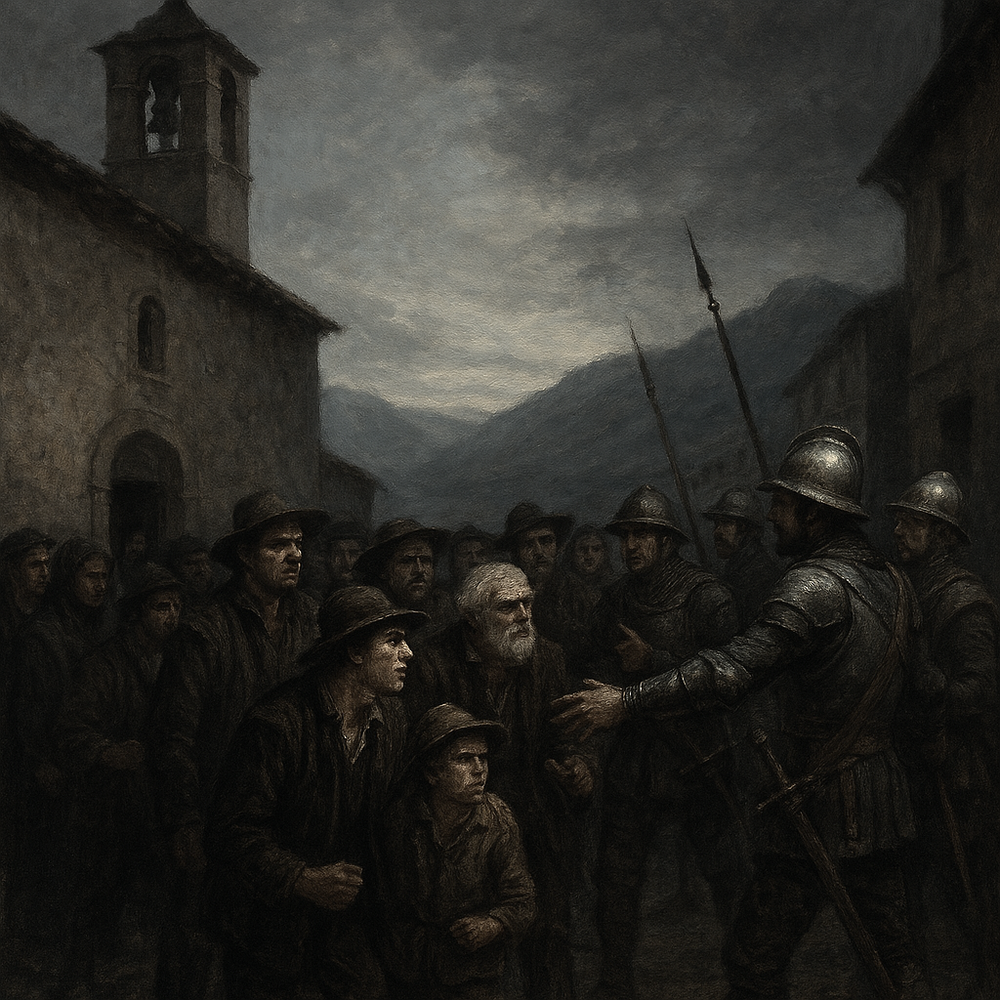
THE next day, which was Sunday, the small church of San Bernardo at Limonta was open, and mass was being said by a friar sent from Milan, as the parish priest had left his cure on account of the interdict, and for this reason was still a fugitive in deadly fear of Pelagrua, who had vowed his ruin. The only persons, however, present at this service were the steward, or proctor, and his family. The people of Limonta, and also many from Civenna and Bellagio, were scattered about the little square, discussing the great event of the day before, the baseness and perfidy of Pelagrua, and whether it were yet possible to avert evil consequences.
Several armed ruffians were marching in the square, trying to get the people into church; but the populace were too firm in their opinions, too irritated by late events, too numerous to allow themselves to be persuaded by fine words, or to be intimidated by the scowls of a handful of swashbucklers. The latter, at last, seeing they could do no good, gave way, and contented themselves with standing sentinel at the door of the church, and from that position attempting to induce those of the crowd who were nearest to them to take off their hats or bow their heads in reverence to the mass. But the people all persisted in standing erect, and keeping on their hats, and amused themselves with passing in front of the sentries, laughing at them, pushing them about, and provoking them with whistling and other noises.
Pelagrua, who was in church, kneeling near the altar, turned his head at these noises, and seeing so many sinister faces and such rough behavior, began to feel alarmed, and wished himself and his family back in his own house.
The celebrating priest, too, under pretence of sending to the choir for some of the sacred altar-vessels, turned and saw the scoffing crowd. The Epistle and the Gospel never seemed to him so long, so he cut his discourse as short as he could. Meanwhile, popular excitement was rising outside.
“What an infamous injustice this is, and how quietly we are taking it!” cried a Limonta lad.
“Why don’t you go to Bellano and offer yourself as our champion?” rejoined an old white-haired man who stood by.
“That’s a nice idea, good shepherd!” replied the first speaker. “Fight with that fellow! He’s a sorcerer, and has a hundred charmed herbs woven into his clothes that make his skin tough.”
“Stefanolo is right. He is well known to be a magician,” said another. “They chose him because no one could hope to pit himself against him and escape with a whole skin. Those heretic hounds are all agreed together to torment us.”
“It would serve them right,” resumed the first speaker, “to begin to do justice for ourselves before they make us lose both body and soul.”
“You are quite right to speak of losing body and soul,” said one of the bystanders, “seeing that the devil himself, in the shape of Pelagrua, is going to mass, now that to do so is a mortal sin; formerly, when it was the proper thing to do, he didn’t trouble himself about it, and now he only goes to draw us on to our ruin.”
“Why, he’s always been a heretic,” went on Stefanolo; “and whoever knew him in former days knows he was excommunicated by our archbishop, and condemned to wear black crosses stitched on his cloak.”
“And his trade, before coming here to bully us, was to forge banknotes,” cried a fresh speaker; “I have often seen him, when I have been at Milan at Christmas, to carry fish to the monastery for the quit-rent. I’ve seen him painted on the wall of the new Broletto, and with a placard underneath, with his name and surname.”
“Burn the house!” “Hang the villain!” “Throw him into the lake!” cried out many voices from the crowd, which kept closing round the speakers.
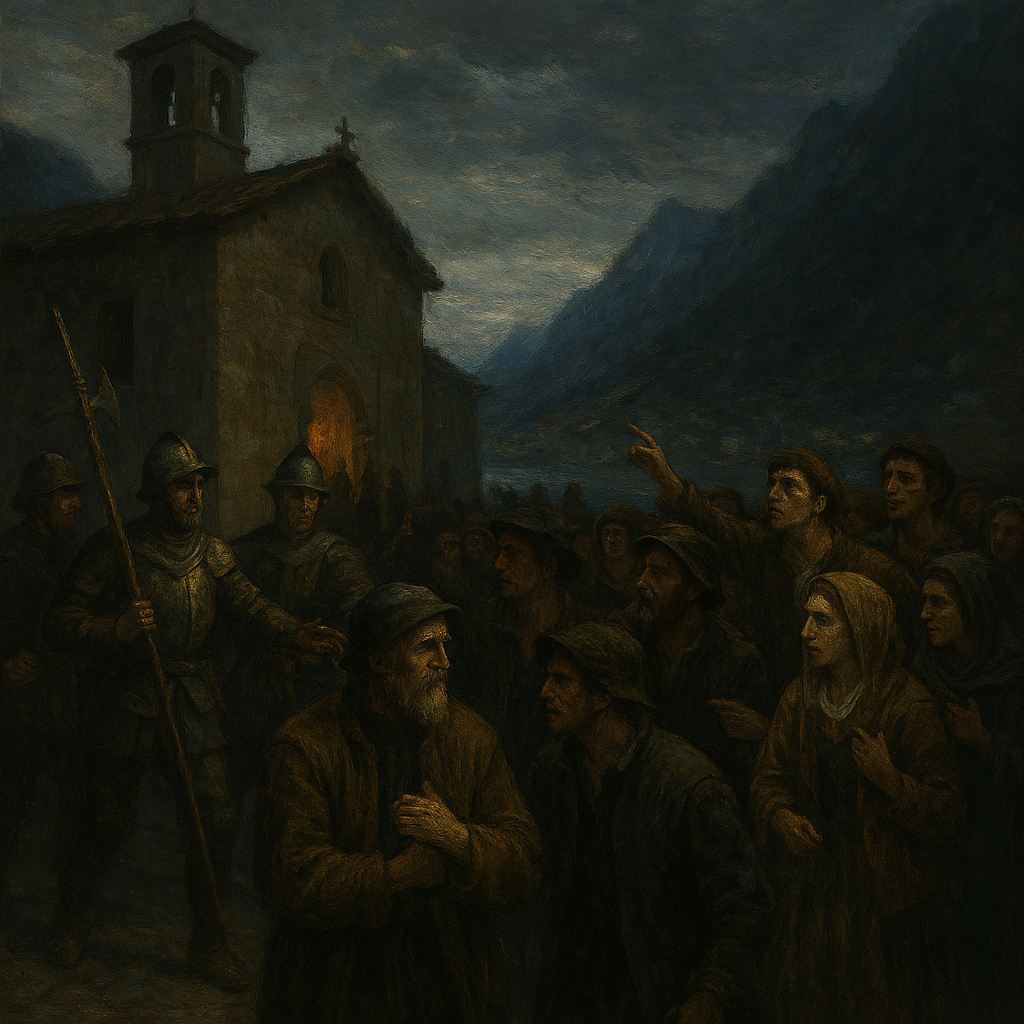
Just then the mass came to an end, and Pelagrua, surrounded by his bravoes, issued from the church on his way to the monastery. The people began to press round, crying out, “Take the heretic, hang him, quarter him, murder him!” making a great noise, as may be conceived, but without harming anyone. Hardly was the procurator inside the threshold, when the door was banged in the face of the crowd, and good-night was the word. On this the mob redoubled their shouts, but as no mischief had really occurred, the storm would have passed away, had it not been for an unlucky outburst of revenge on the part of some of Pelagrua’s braggadocios, who, feeling humiliated at having retreated before a mob of clowns (as they called their opponents), were longing to be at them. Some of them, having got up into a turret beside the door, began to jeer at the crowd and irritate them in every way they could, and declared they would soon make them rue their insolence. On this the outsiders, becoming exasperated, began throwing stones, but without hitting their mark, which only made the opposite side increase their taunts, till at last one of the rogues above had his arm struck by a stone, and, turning quickly to pick up the offending flint, threw it down with all his force, when unluckily it dropped on the head of a child, nine or ten years old, who was among the crowd, shouting as loud as the rest. The boy had his skull fractured, and died in less time than one could repeat a paternoster.
This mishap was like a spark falling into a powder-magazine. The crowd, almost mad with rage, gave a general howl of execration, and shouted for vengeance. In the twinkling of an eye the door was smashed in. The bullies that ran up were dashed to the ground, and a wave of people, rushing through the long passage, poured into the first courtyard. In a moment the house was full of terror and confusion. Doors and windows were fastened in haste, as at the sudden approach of a tempest, and the shrieks of frightened women were heard, as they crossed the galleries pursued by the invaders. Groans and cries arose, together with blows, and prayers for mercy. The few wretches who remained in the tower had no time to save themselves. The people rushed up there furiously, and with their usual impulsive ideas of justice, threw them, one after another, down the castle rock, so as to break every bone in their bodies.
Pelagrua, who was rushing madly about the house, was seized, together with five of his satellites, and tied in a chain with them. Some of the people wished to hurl them headlong from the tower; others to drop them into the lake with stones round their necks; some advised hanging, and others burying alive with the head downward. This last proving the favorite idea, some of the mob ran off to fetch pickaxes and spades, and began to prepare some large holes in front of the church.
The wretched steward, white as a sheet, with his gray hair standing upright on his head, with staring, vacant eyes, ashy lips trembling, and teeth chattering, kept repeating mechanically, in a weak, uncertain voice, “Confession, confession!”
“Oh, you heretic dog! I will confess you with this,” cried Stefanolo, the young fellow who had been so noisy before, and had since been one of the most vehement of the actors in this scene. And, as he spoke, he rushed up with a cudgel, which he was in the act of bringing down on the steward’s head, when the shepherd, who happened to be near, seized his hand.
“What are you thinking of?” he said. “Are we to be worse than Turks? Let him be confessed, if he wishes.”
“And who is there to confess him?” said the other.
“Who? If there is no one else, there’s the friar who came to say mass; he’s still in the church, but dares not come out.”
“That fellow! He is an excommunicated heretic, and cannot confess.”
“Let’s find some one else then—his reverence.” (meaning the parish priest).
“And how is one to find him, driven away as he has been by these rascals? And besides, we are still under the interdict, and no one can confess now—not even he.”
“At the point of death it can be done, and he has confessed others; don’t you remember Tona della Casetta, and Giorgio del Mulino?”
“Well, well; but these rogues are not at the point of death.”
“Yes they are.” “No, they aren’t.” Some declared on one side, and some on the other, and then the clamor was terrific. “Yes, they can be confessed.” “No, they can’t.” After they had gone on for some time in this manner, a voice was heard which settled the question in a way that quieted the crowd. “As soon as they are confessed,” it said, “we’ll make an end of them; so that they may fairly be called at the point of death.” “Yes, that’s true; and now to find His reverence.” “And where is he?” “Last night he slept at the boatman’s.” “Let’s have the boatman.” “Yes, Michael; where’s Michael?” No one had seen him all that day. “I saw Michael going to Como with his son yesterday evening,” said one of the crowd. “But he must have returned, for a little while ago I saw his boat turning the point of Bellagio,” added another. “To the boatman’s house, quick, quick!” cried many voices.
The boatman’s hut was situated on the shore of the lake at the mouth of a little torrent called Auccio, about half-a-mile from Limonta toward Bellagio. The shepherd, who had undertaken to find the priest, met him on the road, in company with the two boatmen, father and son, and a third person, Lupo, the falconer’s son, all just arrived from Como.
The vicar, a good old man, who carried his years lightly, was hastily ascending the steep mountain path in front of the others, when, turning a corner of the rock suddenly, he looked up and saw above him the man who was coming down to fetch him. He stopped abruptly, and called out, “Giammatteo, what is this great disturbance about, down at Limonta? One would think the world was coming to an end.”
“Your reverence,” panted the man, quite out of breath, “come as quickly as you can; no one but you can do anything; make haste, they have taken the palace of the monastery, and are playing the devil there; they want to murder the steward and his men; make haste, for God’s sake!” and the priest hastened away.
Directly his brown cowl appeared at the square they all began to cry, “Here’s his reverence!” and, hastening to meet him, they proposed to him, as a matter of course, to confess Pelagrua and his followers at once, because they wished to kill them. The good man had need of all the authority which his ministry gave him—of all the affection won by a long life spent for the good of his people, and of the fresh glory he had acquired from his persecutions—to dissuade these madmen from their desperate resolve.
What helped most to calm their boiling passions was the news that soon spread through the crowd that Lupo had come, ready to fight for his country against the champion of the monastery. The crowd immediately pressed round the falconer’s son, who implored them to cease from shedding blood, to remain quiet, and to trust to him. Meanwhile the priest entered the steward’s house and managed, after a while, to persuade those who had remained there to pillage to go quietly away. When he had settled matters in the outer court, he passed into the interior of the house, where, fancying he heard a faint cry from above, he went up a wooden staircase, till he came to a door on the landing. On looking through a crevice into the room, he saw, close to one of the side walls, a woman with disheveled hair, on the ground, holding a child tightly to her bosom, and striving to stop its cries with her hand. He recognized her at once as Pelagrua’s wife, and knocked gently at the door, whispering at the same time, “I am the priest. Open the door, for all is quiet.” The poor mother started so suddenly at the first sound that she removed her hand from the child’s mouth, who uttered a sharp cry, which was stifled in a moment; but when the priest went on to say, “Do not be afraid, it is I, all is over!” she sprang up, and turning a large key, opened the door, and showed herself to her deliverer, with the infant in her arms.
“Oh! God has sent you!” said the poor creature, trembling all over. “He will reward you: not for my sake, but for the sake of my poor little angel,” and so saying, she caught hold of the priest’s clothes and kissed them and bathed them with tears in a delirium of joy and gratitude. “And my husband?” she asked anxiously.
“He is safe,” said the priest, and went on: “It will not do for you to be seen about here; go out that way,” pointing to a secret entrance, which opened on the left toward the mountain. “Take the path that leads to the castle, and beg the Count, in my name, to take you in for the night.”
“Oh! but he will refuse, for—”
“Well, show yourself to Ermelinda, tell her—but there is no need to tell her anything. You want help, the Countess will welcome you eagerly, you may be sure. Go, in God’s name.”
The woman departed, and the vicar returned to the square, where the crowd still surrounded the falconer’s son.
“Listen!” he called out. “We must take care that everything is done rightly and in proper form, so that we cannot be found fault with by the archbishop’s official and by the lawyers, who have more quibbles and tricks at their fingers’ ends than hairs on their heads. We must take your votes, and all assemble here to nominate as your champion this good fellow, whom God has sent to us.”
Presently the sacristan of the parish came out on a platform in front of the church, and began to beat, with two little hammers, on a machine composed of a bronze plate, set in the middle of a square table, producing a sharp sound in a kind of cadence, alternately fast and slow. This was a summons to the scene of action. The people assembled, the question was put, and the votes were given. Lupo, as may be guessed, met with no opposition, and was proclaimed unanimously by the whole neighborhood the Champion of Limonta.
Owing to the interval that had already elapsed, and the new interests that occupied their minds, the first outburst of anger and desire for vengeance had subsided, and the multitude, new to bloodshed, began now to experience the reaction naturally resulting from their late proceedings. They now desired to leave the place, to withdraw from the sight of so many witnesses, and to conceal, in the tranquillity of their own homes, the part they had taken in an outbreak which they now clearly foresaw would recoil on the perpetrators. They slunk off quietly, like whipped curs, in different directions, and in a few minutes all was solitude and silence. But, notwithstanding this, Pelagrua would not trust himself to remain in the country, so he went down to the shore of the lake, and, finding a boat, entered it with a few of his followers, and as many of his household as had escaped from the massacre, without waiting to be rejoined by his wife and child, who he learned had taken refuge in the Count’s castle. As he left the shore he looked back at Limonta, and cursed the place, swearing to return before long with the abbot’s forces to take his revenge.
But the abbot, having heard from a messenger of the whole proceeding, flew into a rage with the steward himself, and finding he had gone to Varenna, sent him a most insulting letter, threatening to deprive him of his office, and saying he would make him rue his cowardice in allowing himself to be beaten by a handful of clowns, and driven from the district in so disgraceful a manner. As to the poor people of Limonta, I need not say that the abbot vowed summary vengeance upon them. But even the great cannot always do as they like. In those turbulent times the prelate had to keep his eyes and hands employed in different places at once, and could not bring together at a moment’s notice the forces necessary for his purpose. He therefore pretended to do nothing, and let matters take their course, until he knew the issue of the pending trial at Bellano, which he felt sure would render these mountaineers more helpless than before, and put them irrevocably in his power.
Lupo went at once to the castle of Count Oldrado, where he had been born, and where he expected an affectionate welcome, not only from his parents, but from all the inmates of the place. The news had already arrived of his appearance in Limonta, and of the efforts he had made to appease the furious riot that was going on there. Yet, no one went out to meet him, although many had wished to do so, because the Count, who, at the first rumor of the outbreak, had locked his gates and let down the portcullis, to guard against any attack, would not hear of anyone stirring out till all was quiet.
Admitted at last within the walls, the falconer’s son was greeted by all in the castle with the utmost joy and delight. His father and mother embraced him over and over again, and on all sides questions were poured upon him as to his affairs; and countless blessings were showered upon him. Count Oldrado—though by no means displeased that the poor Limontese had found some one to take their part, and especially one who was clearly a match for the champion of the monastery—would, however, at any other time have restrained himself from evincing his delight, in order not to appear to disagree with the abbot, who was the stronger of the two; but just then the people of Limonta had also shown their teeth and were nearer to him than the abbot. His timid disposition, therefore, led him to make some demonstration in their favor, especially as at the entreaty of his wife and daughter he had given an asylum to Pelagrua’s wife and child, and was now alarmed lest the mountaineers should take offence at this act of kindness. These reasons caused him to give our Lupo a most hearty welcome, and the caresses he showered on him quite astounded and confused the recipient.
Meanwhile, Ermelinda, the Count’s wife, was sitting in a room on the ground floor reading the gospel of the day to her daughter Beatrice, and a young maiden who attended them, named Lauretta, the daughter of the falconer. It was her custom to do this every Sunday, now that, on account of the interdict, they could not attend service in the parish church. She read in Latin, which at that time was still understood throughout Italy.
They were sitting at a small table. Ermelinda was not more than forty years old; she was tall and stately, and of a majestic and pleasing expression. Her face was pale and colorless, and her eyes too often cast down, as if oppressed by some former sorrow which never had been shaken off.
Beatrice was the exact image of her mother, with the same beauty of feature, the same elegance in her form, the same expression in her face and eyes; but everything about her was set off by the fresh beauty of the springtide of life, and enhanced by a sense of happiness, and that mysterious essence which exhales from a soul as yet ignorant of the misfortunes of life, and, so to speak, hardly conscious of its own existence.
When the mother had finished reading, she shut the book, and said to the attendant, “Will you go and see whether that poor woman is in need of anything?”
Lauretta went out, and soon returned to say that she was provided with all that she required, and was now recovered from her great anxiety. She sent the Countess her thanks and blessing, and a request to be sent with her child to the place where her husband had taken refuge.
“You told her,” said Ermelinda, “that I advise her for her own good to stay here till the evening, when I will have her escorted to Varenna?”
“I told her so,” said the maiden, “and she soon acquiesced, and said that she would always pray the Lord to bless you and your house.”
“May God have mercy on her!” said Ermelinda; “she was always a gentle and good woman;” and she repeated with a sigh, “The Lord have mercy on her!”
Here a knock was heard at the door, and the Count entered, leading the falconer’s son, and presented him to his wife and daughter, saying: “Here is our good Lupo, who has come to defend the cause of Limonta.”
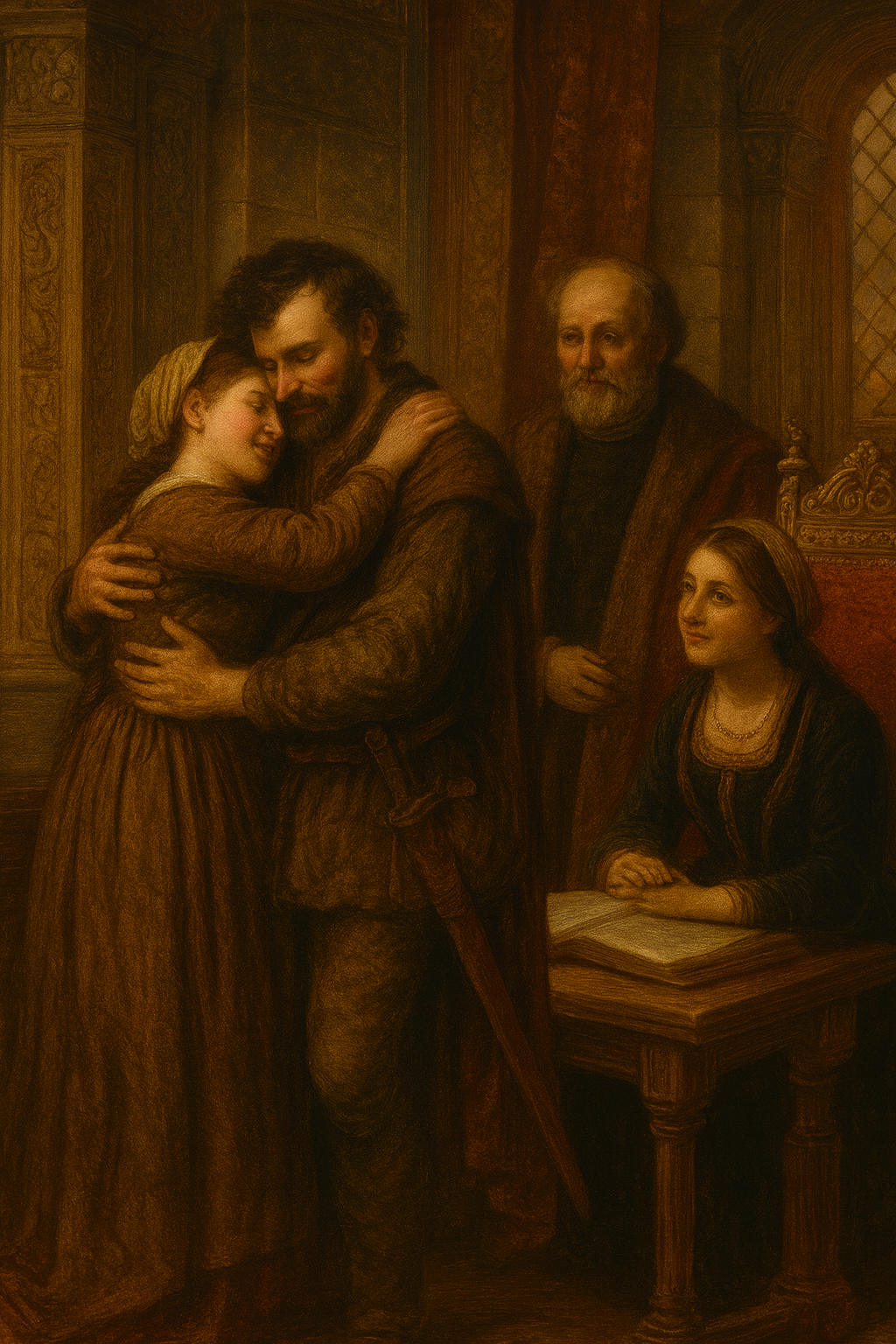
Ermelinda and Beatrice received him with dignified but kindly courtesy; but Lauretta, as soon as she saw the long-desired face of her favorite brother, whom she had not seen for several years, could not control the first impulses of affection; so, running to meet him, she threw her arms around his neck, and held him tightly for a few minutes without speaking; then drawing back for an instant, she blushed deeply, and smiling, half with shyness, half with vexation, said in a trembling voice, “What a silly girl I am! I am delighted to see you, and yet I cannot help crying"

Will follows the "CHAPTER III – Queen of Love and Beauty". Every Friday a new chapter will be published which will also contain the link to the previous one, in any case you will find the list of chapters and their links on the following page: "Marco Visconti - CONTENTS" https://truthdead.ghost.io/ghost/#/editor/post/69976fe24b4dd60001978040
Of course, only published chapters have a link to the relevant page.
The first and second chapters will be open to all, after which they will be reserved for paying subscribers.
I invite you to subscribe as soon as possible by taking advantage of the discounts provided.
Later the Spanish and Italian versions will also be published, as well as the episodes of the television series produced in Italian, and possibly subtitled.
Enjoy the reading.



The Mouth of Truth is a reader-supported publication. To receive new posts and support my work, consider becoming a free or paid subscriber.
In questo spazio non si paga per entrare: si entra perché si riconosce un’eco,
un frammento di sé, un varco che merita di essere custodito.
Se desideri sostenere questo lavoro con un gesto libero, puoi farlo qui:

This space does not ask for payment to enter: you enter because you recognize an echo,
a fragment of yourself, a threshold worth preserving.
If you wish to support this work with a free and voluntary gesture, you may do so here:
En este espacio no se paga por entrar: se entra porque uno reconoce un eco,
un fragmento de sí mismo, un umbral que merece ser cuidado.
Si deseas apoyar este trabajo con un gesto libre y voluntario, puedes hacerlo aquí: