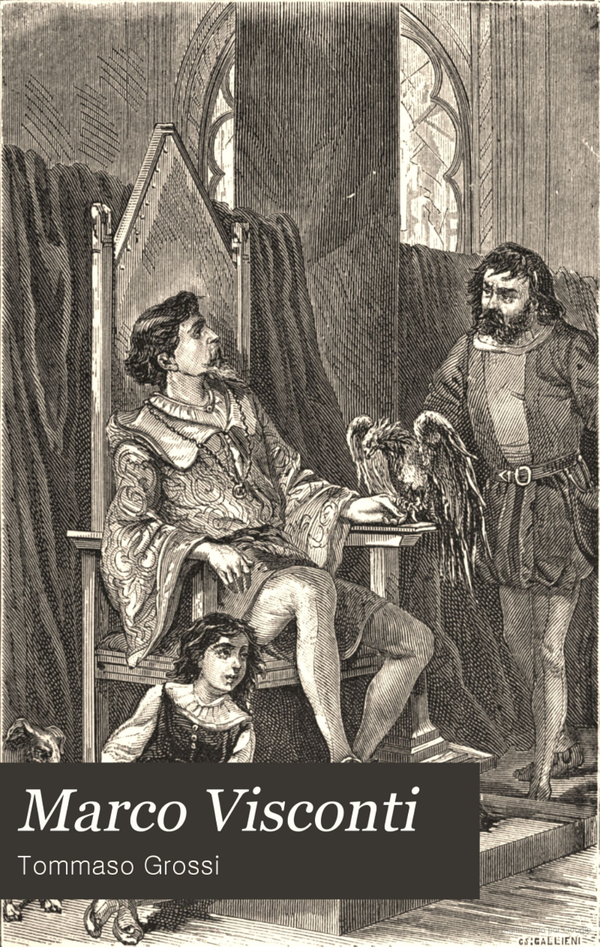

Marco Visconti - Introduction
by Tommaso Grossi
Before Fogazzaro or D’Annunzio or Matilde Serao broke the traditions of the romantic school, to mention modern Italian literature was to think of Manzoni and Grossi. I Promessi Sposi, long known in English as The Betrothed, by Alessandro Manzoni, was the first novel that stood out from the background of the over-effusive, over-passionate and very Byronic works of the Italian romanticists of the early nineteenth century. And the second classic of Italian fiction was Marco Visconti, by Tommaso Grossi. Manzoni and Grossi were close friends, and, in their attitude toward literature, were idealists and sentimentalists. Both were poets, who wrote, perhaps unconsciously, prose masterpieces, while their poetry, on which they lavished great care—and, we can easily imagine, even tears—is forgotten. But an exception to this statement must be made in the case of the little lyric by Grossi, with its refrain, Poverella rondinella, of which William Dean Howells has made a charming version in his Italian Poets.
Pilgrim swallow—pilgrim swallow!
On my grated windowsill,
Singing as the mornings follow,
Quaint and pensive ditties still,
What wouldst tell me in thy lay,
Prithee, pilgrim swallow, say!
And this occurs, not in the poetic works of Grossi, but in the twenty-sixth chapter of Marco Visconti, where the jester and poet, Tremacoldo, sings it for the consolation of the imprisoned Beatrice, and this rondinella, with its recurring refrain, “Swallow, ever wandering swallow,” is as well known today in Milanese households as “Santa Lucia” is at Naples or Venice.
Of Grossi’s works, only Marco Visconti and the swallow-song are well remembered, and both deserve to be well remembered. The novel is most interesting, though it is a series of detached episodes rather than one central action, the foundation for the construction.
It is a vivid picture of Italian feeling and Italian action in the middle of the fourteenth century, before Chaucer had begun to write in England, while Dante and the circle of poets about him had made a finished literature.
One of the chief values of Grossi’s method is that, without affectation of pedantry, he gives you the point of view of the time. You are carried into the depths of the Middle Ages, and, if you yield to his spell, you find yourself looking at life from the point of view of Marco, the splendid prince, and of the troubadour and jester, Tremacoldo, who has been a priest and will be again a priest.
The heroine, Beatrice, is like a hundred heroines of romance, compact of all the virtues; and Ottorino, the leading juvenile lover, has no distinguishing qualities from the genre to which he belongs; but Visconti and the over-prudent father, Count Oldrado, Lupo, the ready-witted and indomitable squire, and the poet Tremacoldo—a kind of Italian François Villon—are of the soil and the time, distinct, and so graphically presented as to seem alive, and to be remembered with the immortal folk in Don Quixote and Gil Blas.
The scene is laid in Lombardy, beloved of Grossi, and the time and circumstances chosen are alien to modern sympathies, because both the time and the circumstances seem at first sight incomprehensible to us. And the charm of Grossi is that he is as simple and naive in his view of life—so far as mediaeval romance goes—as are his characters, the Lombard lords and peasants.
It was an age of terrible elementary passions and unquestioning primitive faith. The Duchy of Milan was under an interdict; no ecclesiastical function could be performed, and no man could confess or be absolved unless in danger of death. The Milanese were not only of the Ghibelline faction, adherents of the Emperor, but they had accepted the jurisdiction of Pietro da Corvano, whom the Bavarian Emperor Louis had declared Pope as Nicholas V, in opposition to the legitimate Pope John XXII, who held court at Avignon.
The inhabitants of the land about Lake Como—a simple and non-political people, mostly peasants—refused to return to the performance of public worship at the command of the anti-Pope. Vital as all the observances of religion were to them, they refused because Pope John included the whole duchy in his interdict. Those who went to mass offered by a Ghibelline priest, the creature of the Emperor’s puppet, were, on the borders of Como, looked upon as heretics.
The usages of religion entered into every detail of domestic life. A tournament to decide guilt or innocence was not valid legally unless the combatants had the blessing of a priest; but a priest that was orthodox could not give this blessing. The admirable passages in which a test of arms is described show how Lupo, by a subterfuge, made his position legal, and how the jester-priest, Tremacoldo, escaped committing what he, as a faithful adherent of the rightful Pope, looked on as sacrilege. In time, when the magnificent Marco Visconti threw himself against the anti-Pope, and John XXII was about to triumph, Tremacoldo sees his way to change his lute to a psalter.
Dante, who had been dead eight years, was looked on by the Guelphs as a pestiferous Ghibelline. The Count, Beatrice’s father, is a Guelph, who, however, wishes to stand well with his powerful Ghibelline neighbors. Beatrice, perplexed and unhappy through the suspected double-dealing of her lover, Ottorino, takes from her table the fashionable book of “devils and tortured souls.” This is the Inferno, the only part of the Commedia Divina then known in Lombardy, where it was as much the vogue as Clarissa Harlowe was in later days in London and Bath.
“Beatrice,” Grossi says, “pursued this study, unknown to her mother, and even the Count required a great deal of urging before allowing her to read the book. It was not at all that he was afraid that the Commedia Divina would not be proper reading for a young girl; it was only because of an old grudge that he had against Alighieri on account of the Latin work entitled De Monarchia, published by that staunch Ghibelline many years before.” De Monarchia had begun to make a great noise in Italy and Germany. “This poisonous book was burned by the common hangman,” the Count tells us. It was afterward taken off the Index, and, though a flaming brand in its day, it is now regarded—by those who put Dante, as Raphael did, in the Disputa, among the doctors of the Church—as a youthful indiscretion.
Marco Visconti, the fierce Lord of Milan, who loves, hates, and revenges with tumultuous power, is a type very misty and unreal to us until we see his picture drawn by a hand like that of Grossi, who is an artist, with few of the lapses of taste that repel us in the romances of his school. And the translator, in Chapter VIII, makes us see him as vividly as we see him walking and speaking through the transparent Italian of Grossi. He delighted to kill an enemy with his own hand. He wore the misericordia, that dagger which had given many an enemy the coup de grâce, permanently at his belt, and set its handle with rubies, like drops of blood. Matteo, his father, had died excommunicated by the Pope, and Marco, who had been high in favor with the Ghibellines, who had slain, ravaged and relentlessly killed all who, in the interest of the Church, opposed him, suddenly demands that his relative, Ottorino, shall become a Guelph and acknowledge Pope John. At heart, this tyrannous and unscrupulous Prince has fear of the thunder of the Church. The memory of his father has often taken the joy from his victories. He weeps bitter tears because he cannot be buried in consecrated ground. Marco tells Ottorino that his father’s despair is always with him. The young man is amazed. He has been brought up to believe that John is the heretic, and Nicholas the rightful Pope; Marco has told him so himself many times. Marco smiles gloomily, but with all his desire not to die excommunicated, he distinguishes between the human and the temporal sides of the Church; his nephew ought to be grateful to the dogs of anti-Pope followers—vile Ghibellines—who have forced him back to the way of salvation.
Grossi’s study of Visconti is the study of a typical Italian lord of the fourteenth century. Though ready to defy the Pope at a moment’s notice for political reasons, and often distrusting and sometimes hating him personally, he acknowledged and feared the spiritual force that he represented, and, by a curious illogic, wondered and believed, lied and oppressed, always in the hope that in the end he might die free from the ban of the Church. Machiavelli, in The Prince, has given us the clue to the politics of Catherine de’ Medici and Elizabeth of England; Grossi gives us, in his presentment of Marco, a complete picture of that very difficult creature of the Middle Ages, a grand seigneur, who was a prince, a bandit, a childlike believer, and a materialist with an ideal. The relations of Lupo—the god in the machine of the romance—with the soldier whose life, for a good cause, he tried to take, are equally typical. Lupo is condemned to death. Vinciguerra, the soldier that has escaped death at his hands, says he will not drink Lupo’s health in wine, but he will save the price to reward the priests for saying masses for his soul.
Modern novels, dealing with that time, all suffer by comparison with Marco Visconti because their authors, in spite of their archaisms, cannot get rid of the point of view of their own time. It is different with Grossi; he loves and comprehends these early Italians as he loves his Lake Como and interprets all its moods.
And Grossi adored this lake. He was born near it, in Bellano, in 1791. He was destined for the law and studied at the University of Pavia. He deserted Pavia for Milan, and also law for literature. He became early the apostle of the lachrymose and pathetic. Charles Dickens himself had no greater power of drawing tears than Grossi. The ladies loved his moving story of Ildegonda. It was in verse, and the patient Griselda’s could not have suffered more than this ill-fated little novice. Horror is piled on horror so high that one wonders how an author so lacking in the sense of proportion and the value of agony for artistic purposes could later have written the sane, well-arranged, and delightfully human Marco Visconti. His poem I Lombardi alla Prima Crociata caused him to be hailed as superior to Tasso, or at least his equal; but it is now as forgotten as the minor knights and palmers of that first crusade, whose names are known only to Heaven.
Marco Visconti is the result of Grossi’s highest talent—one may almost say genius. He appears to have been happy, fortunate in his marriage and in his friendships. After his marriage, which occurred in his maturity, he contented himself with the renown of being the second novelist in Italy, gladly yielding the first place to his friend Manzoni, under whose roof he dwelt for many years. He devoted himself to law. The morality of his great novel is good, and, if the art seems to be too romantic for the realists, one can honestly say, after reading it, that it makes for righteousness. It is both a romance and a novel, as are most of the books by the adorable Walter Scott; for it has the interest of action and the charm of sympathetic characters. We are lured by episodes and are led on by our desire to know how other persons think and live; and this is the chief value of a novel that bears the test of many readings.
MAURICE FRANCIS EGAN

CHAPTER I – Serfs or Freemen – page 1



The Mouth of Truth is a reader-supported publication. To receive new posts and support my work, consider becoming a free or paid subscriber.
In questo spazio non si paga per entrare: si entra perché si riconosce un’eco,
un frammento di sé, un varco che merita di essere custodito.
Se desideri sostenere questo lavoro con un gesto libero, puoi farlo qui:

This space does not ask for payment to enter: you enter because you recognize an echo,
a fragment of yourself, a threshold worth preserving.
If you wish to support this work with a free and voluntary gesture, you may do so here:
En este espacio no se paga por entrar: se entra porque uno reconoce un eco,
un fragmento de sí mismo, un umbral que merece ser cuidado.
Si deseas apoyar este trabajo con un gesto libre y voluntario, puedes hacerlo aquí: