
San Juan de Gaztelugatxe
Natural Monument
Due to its high natural wealth, landscape, and fragility, Gaztelugatxe was declared a Protected Biotope in 1998 and, subsequently, in 2023, it was renamed a Natural Monument. In 2013, it was designated as a Special Area of Conservation (SAC) and a Special Protection Area for Birds (SPA) within the Natura 2000 Network. A Natural Monument seeks to protect ecosystems and stands out for its uniqueness, spectacular beauty, and rarity. They are small spaces where public use is regulated.
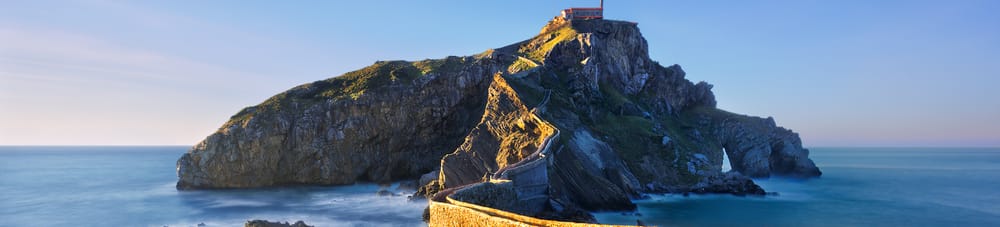
Surely the elements that most attract the visitor's attention are the hermitage of San Juan itself, the islet of Akatx, and Cape Matxitxako. This last point, next to the coastal town of Bermeo, delimits this enclave where the first marine reserve on the Basque Coast was established.
History

Hermitage of San Juan
The hermitage we see today is not the original one: due to events such as battles or fires, the church has had to be rebuilt multiple times.
It is believed that the first hermitage was built in the ninth century, to become a convent during the twelfth century.
The hermitage also had a defensive purpose, protecting the lordship of Bizkaia. Among other historical facts, the King of Castile, Alfonso XI, besieged Gaztelugatxe in 1334, persecuting Juan Núñez de Lara. The latter became strong on the rock along with other Biscayan knights, resisting the attacks for more than a month:
(…) and for this reason, he left Bermeo, and went to surround the Rock of Sanct Joan, which is two leagues from the distance; and this rock is very strong, surrounded by the whole sea, but only with a narrow entrance. And the King settled there, and ordered to bring deceits to fight her, and she dwelt for one month. And there was a good company of fixed men inside the Peña, and they had much food: and for this reason, the King could not collect it at that time while he was (...)
Likewise, imagining that the inaccessibility of the rocky islet relentlessly hit by the waves of the Cantabrian Sea could only hide treasures, has led to assaults on many occasions: among others, at the end of the sixteenth century it is said that the English corsair Sir Francis Drake burned the hermitage and Huguenot heretics, coming from La Rochelle, took Izaro and Gaztelugatxe, stealing everything they found there and throwing their hermit off the cliff. The last incident occurred in 1978, when the hermitage was burned down, prompting its major reconstruction in 1983.